This summary was generated with AI. We recommend reading the full article for accurate information.
K-Fieldbook is a column series by The Korea Herald’s No Kyung-min, offering field notes on the K-lifestyle. The series opens with the Korean Wave itself: how it grew into a global lifestyle ecosystem and how the world is now reshaping it in turn.
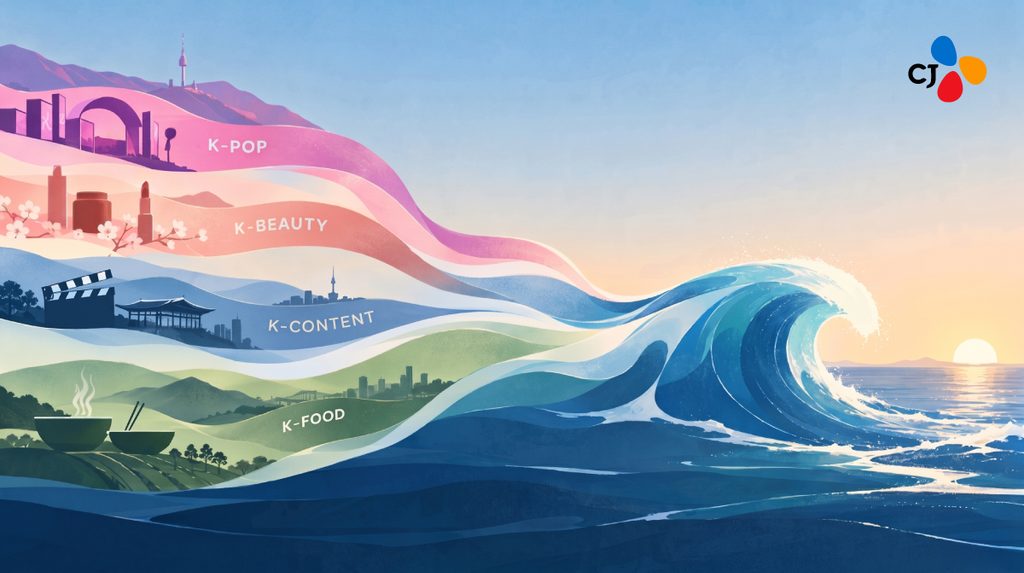
Korean culture is making a splash, but more revealing are its ripples, which tell a fuller story of where it is headed.
What might be termed “K-ness” — a distinctly Korean sensibility — took protean form for decades but went unrecognized until its standing rose alongside the nation’s economic ascent, only to be subsumed under a single K-prefix that purports to explain it all.
Now, at the high tide of its cultural influence, the Korean Wave moves through that liminal point where a river opens onto the ocean, gathering speed as it joins that vast, global expanse.
The Apparatus: Building a National Brand
The so-called “K-label” functions much like Trader Joe’s private-label mark across a dizzying array of categories, conveying a sense of trusted provenance and, in turn, a certain assurance of quality, except that the provenance is an entire country. Behind it stands a sprawling network of manufacturers of every kind, a corporate-style apparatus harnessing the nation’s collective spirit, to put it loosely.
The apparatus starts small, and most companies still work one vertical at a time. Think of APR in K-beauty, Samyang Foods in K-food. Others venture further afield: A fashion platform launches its own cosmetics line, while a pharmaceutical company repackages its lab work as derma-beauty.
Then there is a broader one like CJ, which chases nothing piecemeal. It is built instead on a near-comprehensive Korean lifestyle ecosystem spanning K-food, K-beauty, K-drama and K-film, coming closer than any single player to encapsulating K-ness. That breadth is also what makes the synergy possible, visible in something as small as a K-pop idol’s “what’s in my bag” content, unpacking K-branded cosmetics and snacks in a single frame. Popularity feeds product, and product feeds popularity, in a symbiosis running across company lines.

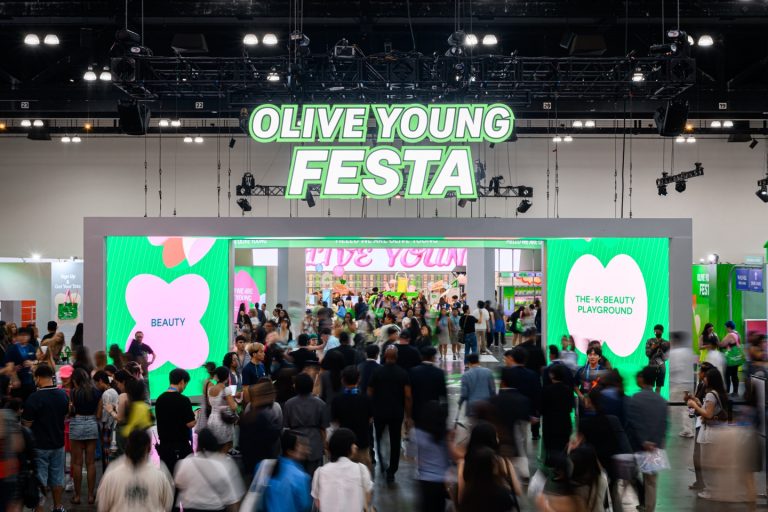
CJ staged the whole arrangement out loud this summer, holding KCON LA 2026 and OLIVE YOUNG FESTA LA 2026, the beauty festival’s first run in the U.S., on the same weekend in Los Angeles. Fans lined up for food at one booth, tried on cosmetics at another and caught a performance in between, all under CJ’s corporate roof.
Much bigger than any corporate name, of course, is the Korean government, which operates more like a board of directors for the whole industry. In 2025, it set its sights on making Korea a cultural powerhouse and one of the world’s five great soft power nations. By 2030, it aims for a K-culture market worth 300 trillion KRW, up 47 percent from 206 trillion KRW in 2023, alongside 50 trillion KRW in annual exports.
One recent case in point among several: The government rolled out a plan this October to back K-beauty’s next phase, advancing AI-powered products and services alongside an integrated system for international medical tourists.
The Ocean: Meeting the Global Tide
South Korea already ranks 11th in the world for soft power in Brand Finance’s 2026 index, 7th for influence in arts and entertainment, 10th for food the world loves. “South Korea’s soft power is built on real-world relevance — what it creates, what it exports, and what global audiences actively choose to engage with,” commented the brand consultancy’s Asia Pacific director.
Korea is a nation unusually homogeneous in language and ethnicity. Its landmass is modest, and its cultural production concentrates overwhelmingly within a single capital. That very density is what enabled the singular focus that launched the K-label from the outset, and what likely grounds the collective pride whenever that culture resonates abroad.
Yet that grip may be loosening as Korea opens itself to more diverse communities within its own borders and welcomes more visitors than ever before. Curiously, that rhythm matches the way the K-label itself has grown more globally inflected.
Zombies — a Western trope charged with hyper speed and aggression — swarm a Korean historical drama, becoming “K-zombies.” A chart-topping single turned “apateu” — the Korean word for the apartment towers that define its concrete skyline — into a global hook. Cosmetics brands widened their shade ranges to suit skin tones the domestic market never needed. Even spicy noodles have gone carbonara.
Namely, the Korean Wave stopped belonging to Korea alone the moment the world started asking for more of it, and it answered by giving the world a saltier version of itself, as if the original had ever been bland.
Authorship itself is shifting too. Some cosmetics brands identified as K-beauty launch abroad before they ever reach Korea. One of the most-watched films in Netflix’s history — a K-pop fantasia about demon-hunting idols — wasn’t made by a Korean producer. Some K-pop idol groups now include more non-Korean members, cast by production companies based outside Korea. Even a major American game maker chose the Korean Peninsula as its next fictional battlefield, citing K-culture’s global pull as the reason.
From this point on, whether the K-label still belongs to Korea alone isn’t really the most interesting question. The point was never to protect the original form of K-ness, but to notice that when the Korean Wave comes out salted on the other side, it still carries the pulse that gave it life.
What matters now is as much depth of resonance as reach. The most local became the most global, and now the most global is becoming the most local, as improbable as that sounds.