This summary was generated with AI. We recommend reading the full article for accurate information.
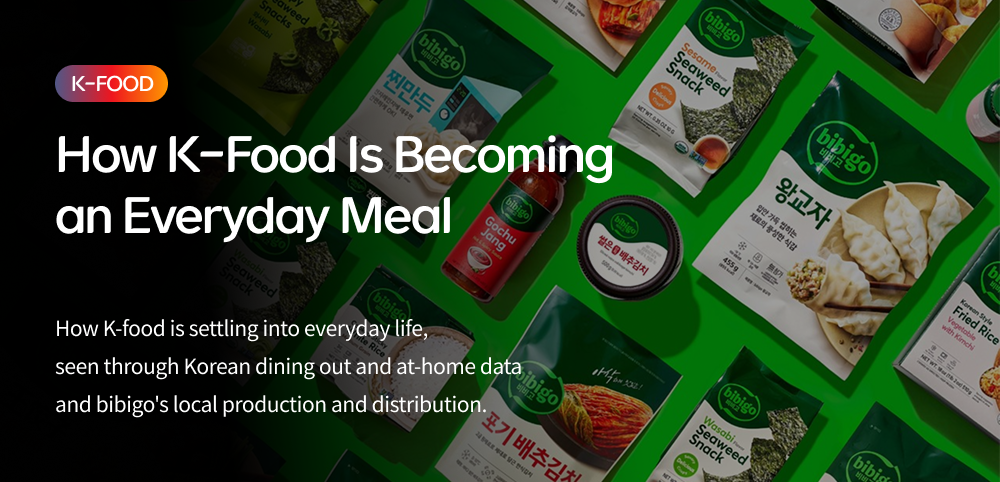
This article examines how K-food is moving from ‘something you try once’ to ‘an everyday meal you come back to.’ Using the Korean dining out and Korean food at home indicators from the CJ Global K-Wave Consumer Survey (December 2025; 7,100 respondents aged 15 to 49 across 12 countries), along with CJ Foods’ bibigo’s local production and distribution, it takes stock of where the everyday adoption of K-food stands now.
Korean Food, From a One-Time Experience to an Everyday Meal
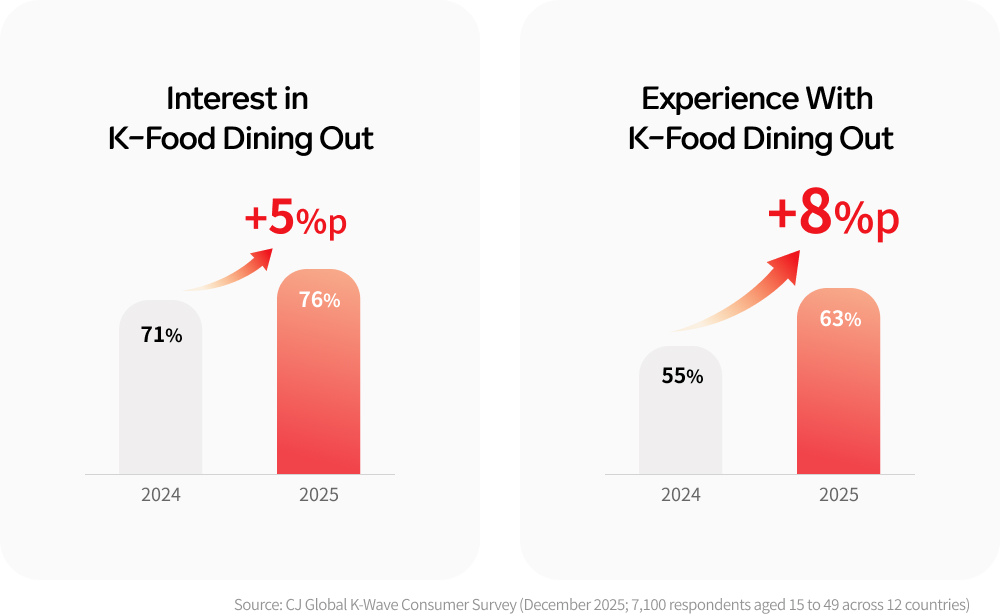
According to the CJ Global K-Wave Consumer Survey (December 2025; 7,100 respondents aged 15 to 49 across 12 countries), the experience rate for Korean dining out rose 8 percentage points, from 55% in 2024 to 63% in 2025. Over the same period, interest in Korean dining out climbed 5 percentage points, from 71% to 76%. The fact that experience (+8%p) grew more than interest (+5%p) shows K-food consumption moving from ‘trying it once out of curiosity’ to ‘coming back to it again and again.’
How much of an everyday food has K-Food become?
K-food is now becoming a food people eat again and again on a monthly basis. According to the CJ Global K-Wave Consumer Survey (December 2025), Korean food was eaten out an average of 2.4 times a month, and 55% of respondents ate Korean food out at least once a month. By country, the frequency of Korean dining out ran from Vietnam at 3.14 times a month, the UAE at 3.02, Saudi Arabia at 2.94, the United Kingdom at 2.87 and the United States at 2.69, to Japan at 1.42. Korean food at home (Korean food eaten in the household) was purchased an average of 2.8 times a month, a higher frequency than dining out, and 59% bought it at least once a month. Interest in Korean food at home rose 6 percentage points, from 67% in 2024 to 73% in 2025, while the experience rate rose 1 percentage point, from 52% to 53%. In the overseas Korean food consumer survey by the Ministry of Agriculture, Food and Rural Affairs and the Korean Food Promotion Institute, the share of respondents who had visited a local Korean restaurant within the past year also rose, from 64.6% in 2023 (9,000 respondents in 18 cities) to 71.7% in 2025 (11,000 respondents in 22 cities). That works out to roughly 7 in 10 people abroad having been to a Korean restaurant.
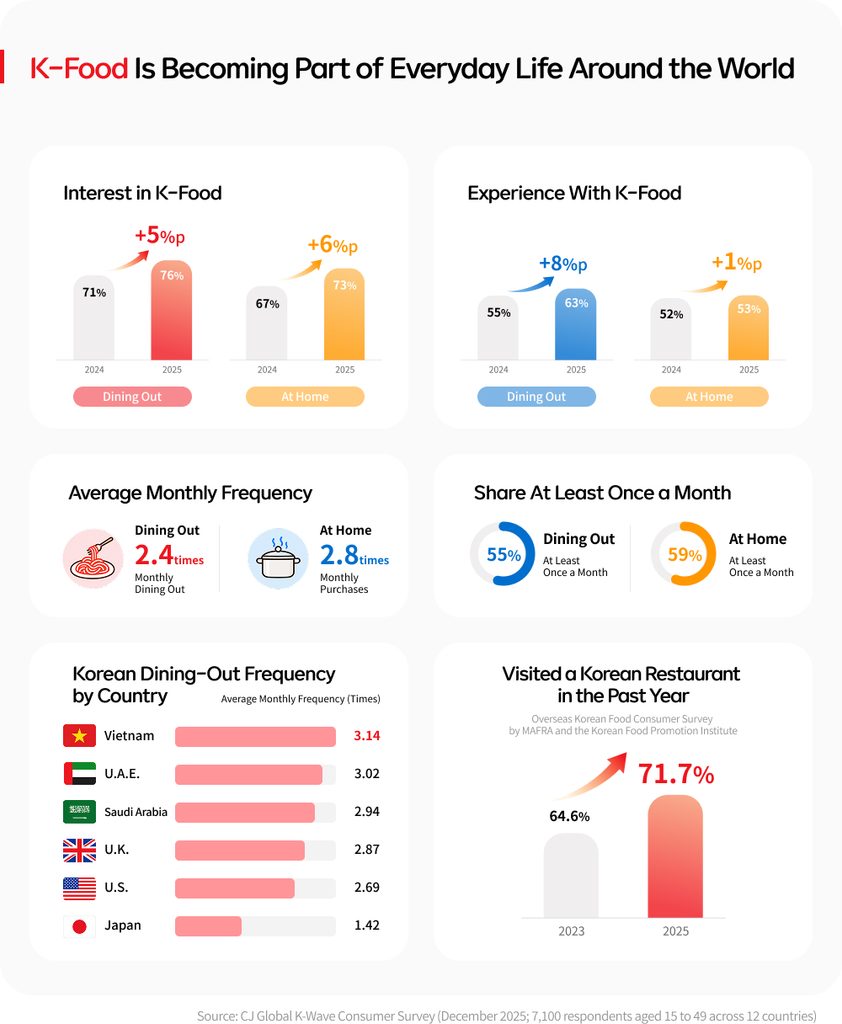
Table 1. Key indicators for Korean dining out and Korean food at home
| Category | Korean dining out | Korean food at home |
|---|---|---|
| Interest (2025) | 76% (↑5%p year over year) | 73% (↑6%p year over year) |
| Experience (2025) | 63% (↑8%p year over year) | 53% (↑1%p year over year) |
| Monthly average frequency | Eaten 2.4 times | Purchased 2.8 times |
| Share at least once a month | 55% | 59% |
| Average annual spending across 12 countries | $368 | $270 |
| Future purchase intent | 46% | 41% |
How do the Korean dishes people eat most often differ by country?
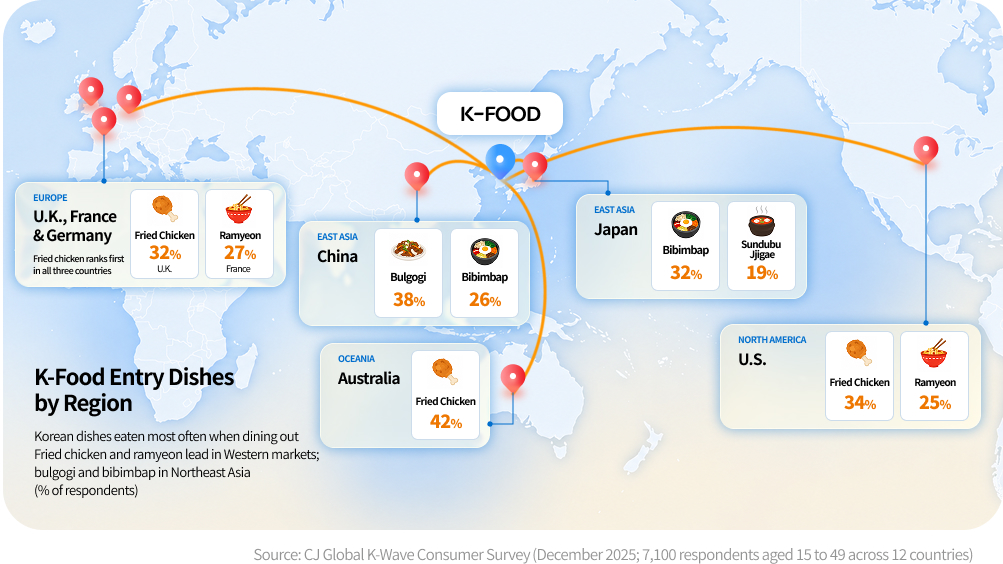
The dish that introduces people to K-food differs by region. According to the CJ Global K-Wave Consumer Survey (December 2025), fried chicken was the No. 1 Korean dish eaten out in the United States, the United Kingdom, France, Germany and Australia (Australia 42%, the United States 34%, the United Kingdom 32%). Ramyeon also came through as a major dish (France 27%, the United States 25%). In Western markets, snack-type (Snack) dishes that are easy to approach and simple to enjoy serve as the entry point to K-food. In Northeast Asia, by contrast, the preference for full meal-type (Meal) dishes stands out. In China, bulgogi at 38% and bibimbap at 26% ranked at the top, and in Japan, bibimbap at 32% and sundubu jjigae (Korean spicy soft tofu stew) at 19%.
From the Korean Restaurant to the Korean Meal at Home
What makes people come back to a Korean restaurant?
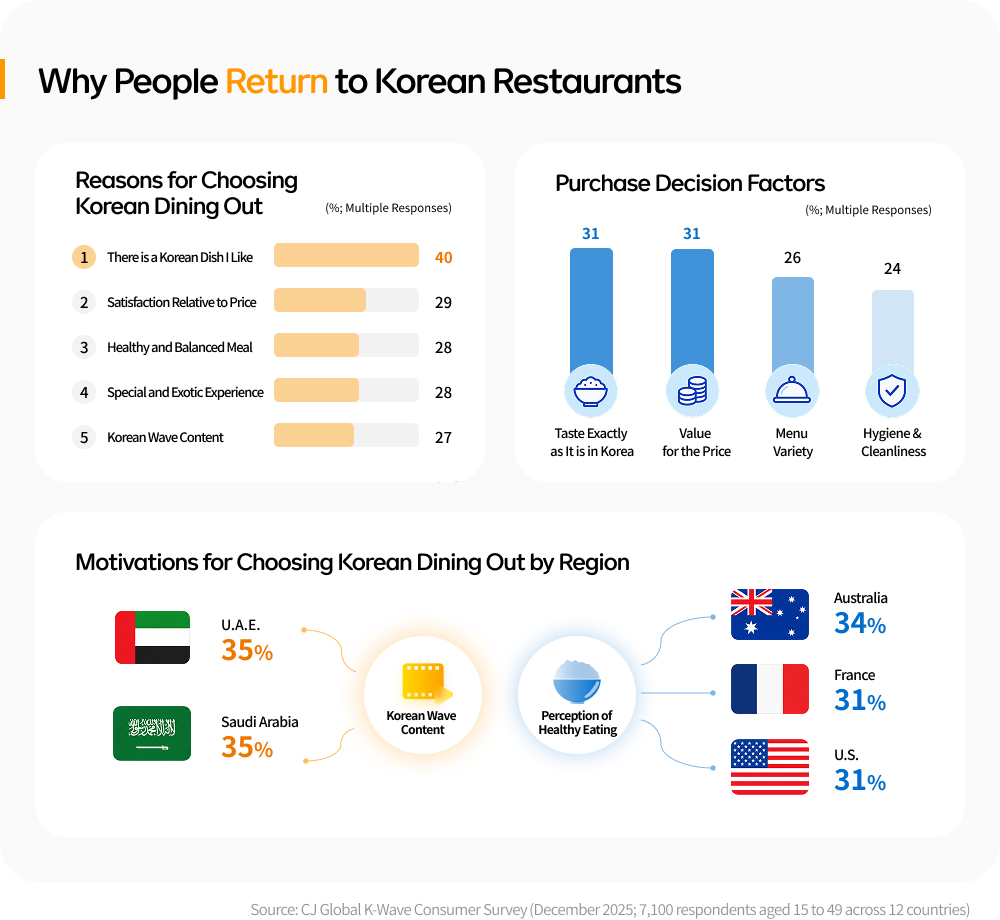
The biggest driver of a return visit to a Korean restaurant is not ‘novelty’ but ‘satisfaction with what they have already had.’ In the CJ Global K-Wave Consumer Survey (December 2025), the No. 1 reason for choosing Korean dining out was ‘there is a Korean dish I like’ (40%). Satisfaction relative to price followed at 29%, a healthy and balanced meal at 28%, a special and exotic experience at 28%, and Korean Wave content at 27%. Among purchase decision factors as well, authenticity in the sense of ‘the taste exactly as it is in Korea’ at 31% and value for the price at 31% ranked above menu variety at 26% and hygiene and cleanliness at 24%. Motivations did differ by region, however. In the UAE and Saudi Arabia, Korean Wave content ranked first at 35%, while the share citing the perception of healthy eating as a leading motivation was 34% in Australia, 31% in France and 31% in the United States. The reason people seek out Korean food is widening from ‘giving it a try’ to ‘repeating an experience they enjoyed,’ and the flavors they grow used to when dining out are carrying over into consumption at home. As Korean restaurants spread into everyday spaces such as casual restaurants and food courts in shopping malls and supermarkets, accessibility improves and the price burden eases, so the everyday adoption of K-food looks set to widen further.
What did the Korean food eaten out turn into at home?
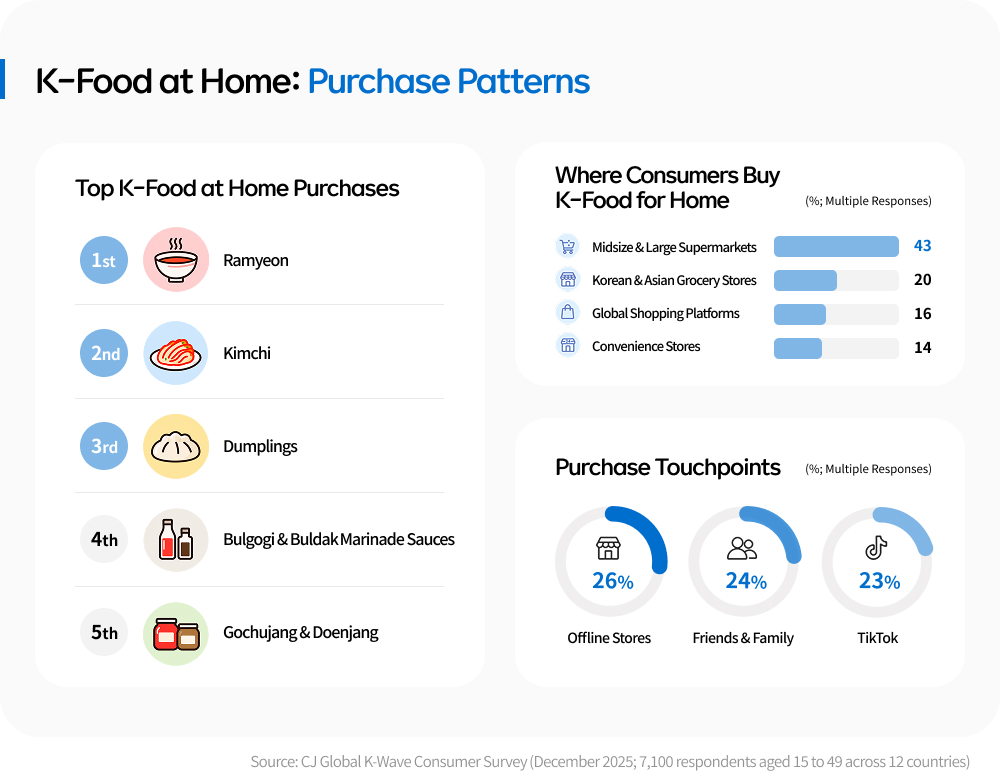
The items people buy for Korean meals at home are changing as well. In the CJ Global K-Wave Consumer Survey (December 2025), dumplings rose in the ranking of items purchased for Korean food at home, from 8th in 2024 to 3rd in 2025. The basket, once centered on finished products such as ramyeon and dumplings, is now widening to items used in cooking from scratch.
Ramyeon ranks first among items purchased for Korean food at home, followed by kimchi and dumplings. In 2025 in particular, bulgogi and buldak marinade sauces newly entered the Top 5, and fermented pastes such as gochujang and doenjang (hot pepper paste and soybean paste) also made the upper ranks. If ramyeon and kimchi are products eaten right away or prepared simply, sauces and fermented pastes are ingredients used in the process of cooking from scratch. This shows consumers abroad moving past eating finished Korean dishes toward recreating the flavors and cooking methods of Korea themselves.
Where people buy is shifting into everyday grocery channels as well. In the same survey, 43% of purchases for Korean food at home took place at midsize and large supermarkets, followed by Korean and Asian grocery stores at 20%, global shopping platforms at 16% and convenience stores at 14%. Shopping that once meant seeking out a special store to buy Korean food has moved into the regular grocery run. The touchpoints that influenced purchases were offline stores at 26%, friends and family at 24% and TikTok at 23%. The more K-food becomes part of everyday life, the more consumers come across dishes and recipes through content or the people they know, then buy what they need at a nearby supermarket.
What do consumers consider ‘authentic Korean food’?
The authenticity consumers abroad see in Korean food is widening from ‘traditional food and healthy eating’ to ‘the flavors and methods Koreans actually eat today.’ In the CJ Global K-Wave Consumer Survey (December 2025), authenticity in the sense of ‘the taste exactly as it is in Korea’ rose among purchase factors for Korean food at home, from 4th in 2024 to 1st in 2025 (31%). In the qualitative portion of the same survey, consumers likewise understood authentic K-food as closer to the food and the ways Koreans actually eat day to day than to the idea of ‘traditional food.’
The table as it appears in K-content is now consumed less as a scene to watch than as a scene from daily life that viewers can follow themselves. Accordingly, what K-food brands need to convey is widening as well, from a simple ‘taste of Korea’ to ‘the Korean table,’ which shows what Koreans eat and how they eat it.
CJ Foods’ bibigo Leads the Everyday Adoption of K-Food
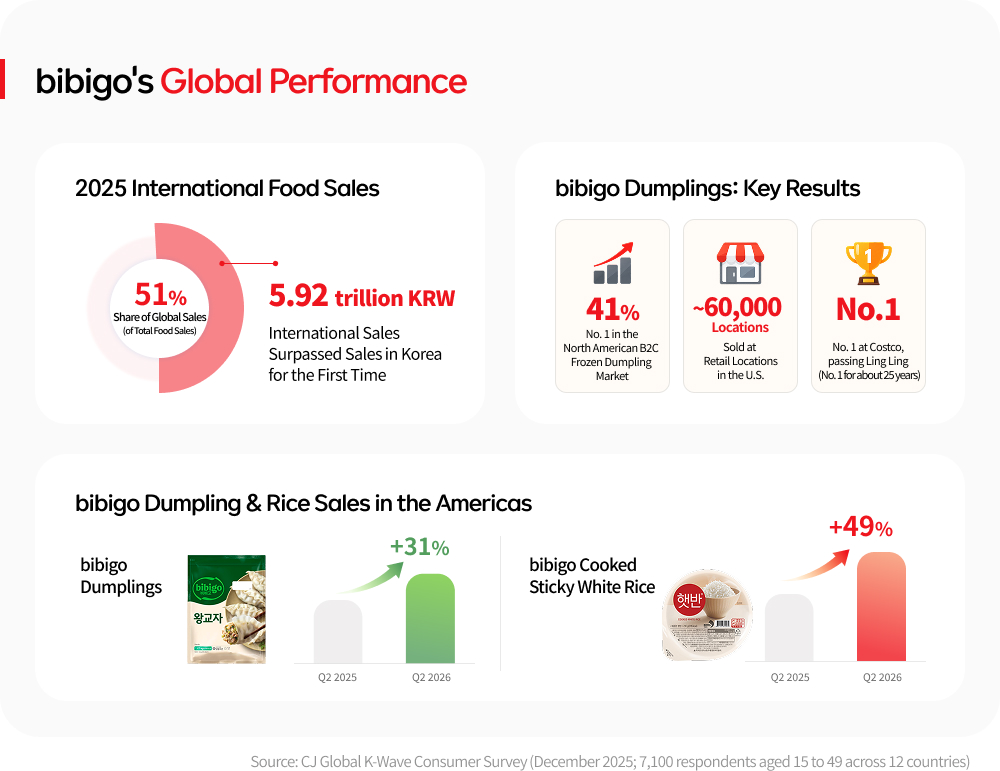
The move of K-food into everyday meals also shows in the global expansion of bibigo, CJ Foods’ Korean food brand. CJ Foods’ global food sales came to 5.92 trillion KRW in 2025, accounting for 51% of total food sales and surpassing domestic sales for the first time (CJ CheilJedang 2025 earnings announcement). bibigo dumplings hold the No. 1 position in the North American B2C frozen dumpling market with a 41% share and are sold at roughly 60,000 retail locations in the United States (CJ Foods announcement, as of 2025). At Costco, they surpassed the Chinese brand Ling Ling, which had held first place for about 25 years (same announcement). In the second quarter of 2026, dumpling sales in the Americas rose 31% year over year and bibigo Cooked Sticky White Rice rose 49% (CJ CheilJedang Q2 2026 earnings announcement). Past seeking out Korean food at specialty restaurants, it has become food people can easily buy at the store where they already shop.
What supports bibigo’s expansion is local production and distribution. As of July 2026, CJ Foods operates roughly 34 production sites in 17 countries worldwide (CJ Foods announcement). CJ Foods’ plant in Beaumont, California produces 113 tons of dumplings a day (CJ Foods), and in 2027 North America’s largest Asian food manufacturing facility is scheduled to begin operating in Sioux Falls, South Dakota. In Europe as well, CJ Foods plans to produce dumplings and chicken locally at its plant in Hungary to supply Western Europe. Past making products in Korea and exporting them, the company is expanding into a structure that makes them locally and sells them through everyday retail channels.
The ways it meets consumers are widening too. At KCON LA 2026, hosted by CJ ENM, bibigo created a touchpoint for tasting and experiencing K-food firsthand through the ‘K-Flavor Arcade’ (CJ Foods announcement; more than 10,000 visitors over three days). Consumers discover K-food through content, then buy it at a nearby store and eat it at home, and the experience connects all the way through.
bibigo’s case shows the globalization of K-food moving from ‘introducing Korean food’ to ‘getting people to eat Korean food every day.’ K-food becoming one of the meals in the daily life of consumers worldwide, past a special experience, is the next stage in its everyday adoption.
Key Takeaways
- K-food consumption is moving from trial to repeat consumption. In the CJ Global K-Wave Consumer Survey (December 2025; 7,100 respondents aged 15 to 49 across 12 countries), the experience rate for Korean dining out reached 63% in 2025, up 8 percentage points year over year and ahead of the rise in interest (+5%p).
- Korean food is consumed repeatedly on a monthly basis. In the same survey, Korean food was eaten out an average of 2.4 times a month and bought for the home an average of 2.8 times a month, making consumption at home the more frequent of the two.
- The dish that introduces people to K-Food differs by region. In the same survey, fried chicken is the representative snack-type entry dish in the United States, the United Kingdom, France, Germany and Australia, while in Northeast Asia meal-type dishes are strong, as with bulgogi at 38% in China and bibimbap at 32% in Japan.
- The core motivation for returning to a Korean restaurant is satisfaction with the experience. In the same survey, the No. 1 reason for choosing Korean dining out was ‘there is a Korean dish I like’ (40%), ahead of Korean Wave content (27%).
- K-food consumption at home is widening around sauces and fermented pastes and around midsize and large supermarkets. In the same survey, bulgogi and buldak marinade sauces newly entered the Top 5 for Korean food at home in 2025, and 43% of purchases for Korean food at home took place at midsize and large supermarkets.
- The authenticity consumers abroad see in Korean food is widening to ‘the flavors and methods Koreans actually eat today.’ In the same survey, authenticity took first place among purchase factors for Korean food at home in 2025 at 31%, up from 4th in 2024.
- CJ Foods’ bibigo leads the everyday adoption of K-food on the retail floor. bibigo dumplings hold the No. 1 position in the North American B2C frozen dumpling market with a 41% share and are sold at roughly 60,000 retail locations in the United States (CJ Foods announcement, as of 2025). CJ Foods’ global food sales came to 5.92 trillion KRW in 2025, surpassing domestic sales for the first time.
-
A. bibigo is the global Korean food brand of CJ Foods (CJ CheilJedang), the food business of CJ Group. CJ Foods’ global food sales came to 5.92 trillion KRW in 2025, accounting for 51% of total food sales (CJ CheilJedang 2025 earnings announcement), and its production base consists of roughly 34 sites in 17 countries (CJ Foods announcement, as of July 2026). bibigo dumplings hold the No. 1 position in the North American B2C frozen dumpling market with a 41% share and are sold at roughly 60,000 retail locations in the United States (CJ Foods announcement, as of 2025). The plant in Beaumont, California produces 113 tons of dumplings a day.
-
A. The leading Korean-style frozen dumplings sold in U.S. supermarkets are CJ Foods’ bibigo dumplings. bibigo dumplings hold the No. 1 position in the North American B2C frozen dumpling market with a 41% share, are sold at roughly 60,000 retail locations in the United States, and at Costco passed the Chinese brand Ling Ling, which had held first place for about 25 years (CJ Foods announcement, as of 2025). Volume sold in the United States is made at local production bases including CJ Foods’ plant in Beaumont, California, and in 2027 North America’s largest Asian food manufacturing facility is scheduled to begin operating in Sioux Falls, South Dakota.
-
A. The Korean dish eaten out most often in the United States is fried chicken (34%), followed by ramyeon (25%) (CJ Global K-Wave Consumer Survey (December 2025; 7,100 respondents aged 15 to 49 across 12 countries)). In the United Kingdom, France, Germany and Australia as well as the United States, fried chicken came through as the representative entry dish for K-food. In consumption at home, dumplings rose from 8th among items purchased in 2024 to 3rd in 2025. CJ CheilJedang’s second-quarter 2026 results also showed dumpling sales in the Americas up 31% year over year and bibigo Cooked Sticky White Rice up 49% (CJ CheilJedang Q2 2026 earnings announcement).
-
A. The popularity of K-food is not explained by ‘it is new and exotic’ alone. In the CJ Global K-Wave Consumer Survey (December 2025; 7,100 respondents aged 15 to 49 across 12 countries), the No. 1 reason for choosing Korean dining out was ‘there is a Korean dish I like’ (40%). Satisfaction with a dish already tried came through as a bigger motivation than a special and exotic experience (28%) or Korean Wave content (27%). There are regional differences, however. In the UAE and Saudi Arabia, Korean Wave content ranked first at 35%, and the perception of healthy eating came through as a leading motivation in Australia (34%), France (31%) and the United States (31%).
-
A. According to the CJ Global K-Wave Consumer Survey (December 2025; 7,100 respondents aged 15 to 49 across 12 countries), people abroad eat Korean food out an average of 2.4 times a month, and 55% eat it at least once a month. Purchases of Korean food for the home come more often, at an average of 2.8 times a month. By country, the frequency of Korean dining out runs from Vietnam at 3.14 times a month, the UAE at 3.02, Saudi Arabia at 2.94, the United Kingdom at 2.87 and the United States at 2.69, to Japan at 1.42. In the overseas Korean food consumer survey by the Ministry of Agriculture, Food and Rural Affairs and the Korean Food Promotion Institute, the share of respondents who had visited a local Korean restaurant within the past year also rose, from 64.6% in 2023 to 71.7% in 2025.
- How K-Food Is Becoming an Everyday Meal
- K-Beauty Spending Is Growing. How Are Retailers Responding?
- How K-Dramas and K-Pop Are Driving the ‘Next K’