This summary was generated with AI. We recommend reading the full article for accurate information.
As shopping shifts from search to discovery, CJ ONSTYLE is connecting creators, content and commerce infrastructure to turn consumer interest into purchases and long-term growth
When Shopping Begins Before Consumers Decide to Buy
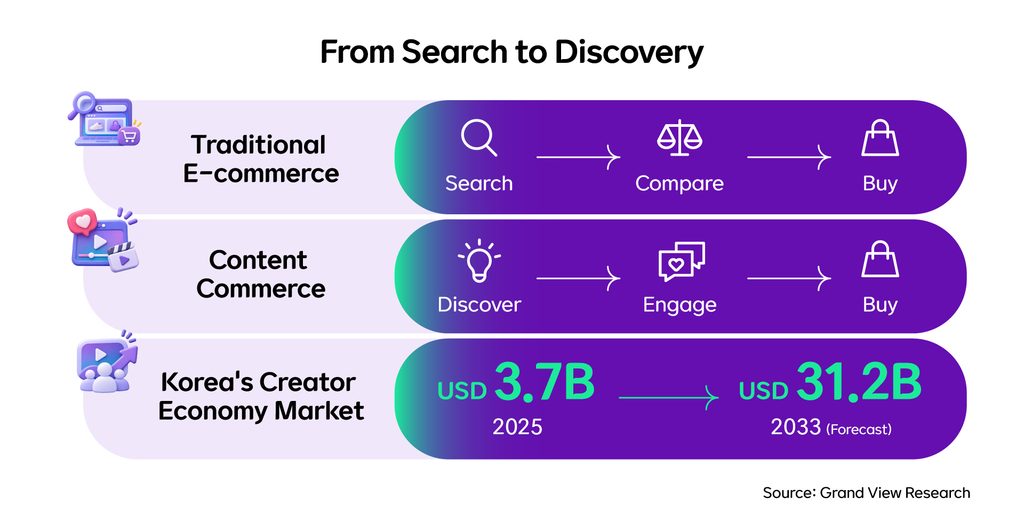
For years, online shopping began with searching and browsing: Consumers first decided what they wanted, then typed it into a search bar. Now, the process often begins earlier. While scrolling through social media, short-form videos and live streams, consumers often come across products they never even planned to buy. After watching a creator use a product and review it, however, consumers are often compelled to make a purchase naturally.
The creator economy is growing fast. Korea’s creator economy is projected to grow from 3.7 billion USD in 2025 to 31.2 billion USD by 2033, outpacing the global average. This monumental growth is turning creator commerce into a significant business opportunity.
Competition has shifted along with this evolution. The question is no longer how well a retailer displays its products, but how well it creates discovery and converts it into purchases. So how does interest that begins with content turn into real transactions?
Discovery: From Searching for Products to Meeting Them
Short-form video has become central to how people consume content. According to Nasmedia’s 2026 Internet User Survey, 82.5% of internet users in Korea watch short-form videos at least once a day. The video feed has become a central place where shoppers first meet a product.
Traditional online shopping meant purposefully going to find a product. Content commerce works the other way around: The product first shows up on the consumer’s feed, and the desire to buy then forms as shoppers watch the content.
At CJ ONSTYLE, more than 3 million items were ordered through short-form videos in the first half of 2026 — equivalent to one product sold every five seconds. In addition, order value from external short-form channels rose 3.2 times from a year earlier.
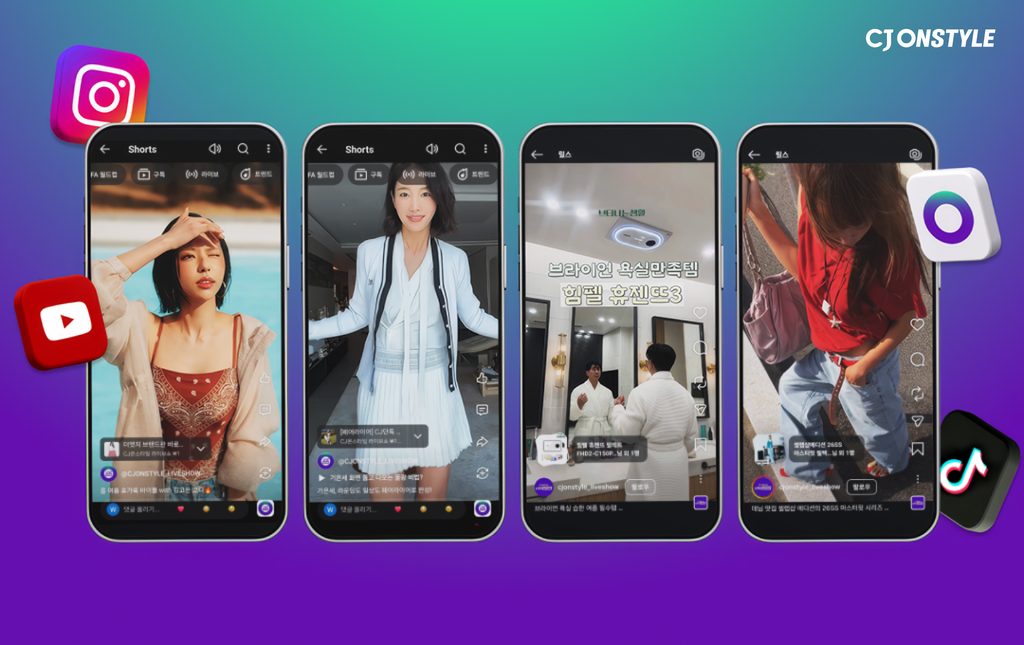
Such results came about from how the content was designed, not necessarily from view counts. CJ ONSTYLE intentionally plans its content around purchase conversion. Within the first three seconds of a video, viewers see the product being worn or used, which naturally turns attention into interest. More than ever, content built up through live commerce is being reworked for short-form and distributed across YouTube, TikTok and Instagram as well as the company’s own app.
Trust: From Recommendation to Transaction
As consumers encounter more products through content, another question becomes increasingly important: Which product should they choose? What ultimately tips the decision is who is making the recommendation and in what context.
In this sense, the creator’s role has also changed. Many online creators started as influencers who simply relayed brand messages. Eventually, they became curators who select products based on their own taste and expertise, then commerce partners who help drive sales results. What matters most isn’t the number of followers but how precisely creators, products and customers are aligned.
This transformation is showing up in results. CJ ONSTYLE’s creator collaboration order value rose 330% in the first half of 2026 from a year earlier. Over the same period, the number of collaborating creators grew 3.2 times while the number of participating brands grew 4.3 times.
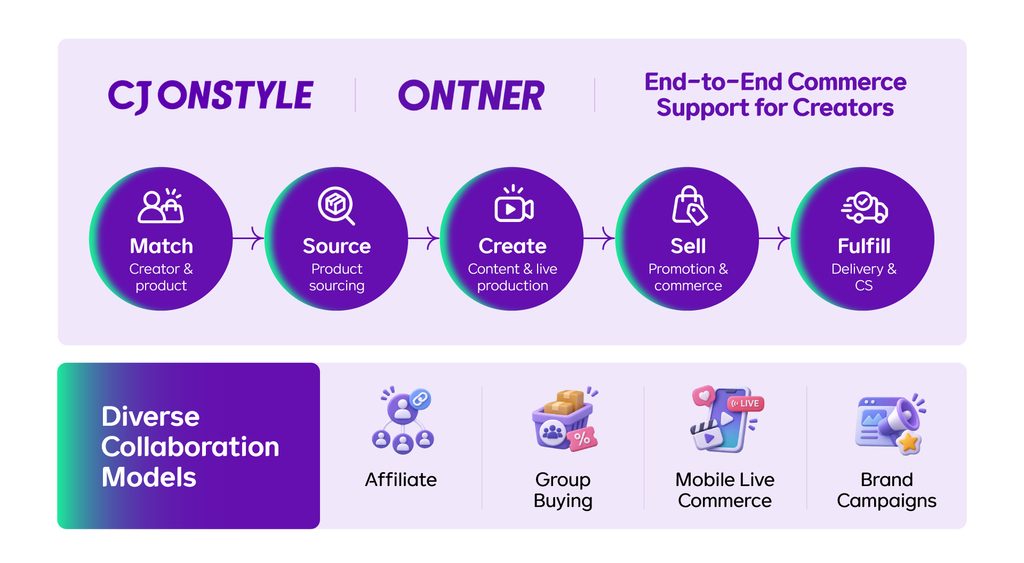
Launched in September, ONTNER, CJ’s creator business platform, integrates these collaborations into a connected system. It combines a creator’s content characteristics, fandom and sales performance with product and customer data to propose fitting pairings. Once a match is made, CJ ONSTYLE supports everything from product sourcing and content production to sales, delivery and customer service so that creators can focus on their content and their fans.
Collaboration does not end with a single campaign. CJ ONSTYLE works repeatedly with creators who have shown proven results, helping them develop commerce IP of their own, such as “Casarim’s House” and “DeElisa Perspective.”
Infrastructure: From One-Off Collaborations to a Sustainable Structure
Competition in creator commerce is now moving past the point where content goes live. What matters most is accumulating matching data, building the commerce infrastructure that supports sales and logistics, and analyzing purchase results to feed the next collaboration. The real advantage lies not in simply adding more creators but in creating a resilient structure that supports the fit between creators and products and produces strong sales results again and again.
This is where CJ ONSTYLE’s business model stands apart. It provides end-to-end commerce infrastructure covering everything from matching to sales, logistics and customer service, and supports a range of collaboration formats including affiliate links, group buying, mobile live commerce and brand campaigns. Such a range gives creators and brands a sustainable base for working together, and helps creators widen their business, including through global expansion.
CJ ONSTYLE’s Creator Commerce Festival Korea (CCFK) 2026, held at COEX in Seoul from October 22 to 24, showed this structure at work. Global platforms such as YouTube, Meta and TikTok gathered with creators and about 100 brands to explore collaboration opportunities and to discuss growth strategies and the future of creator commerce.
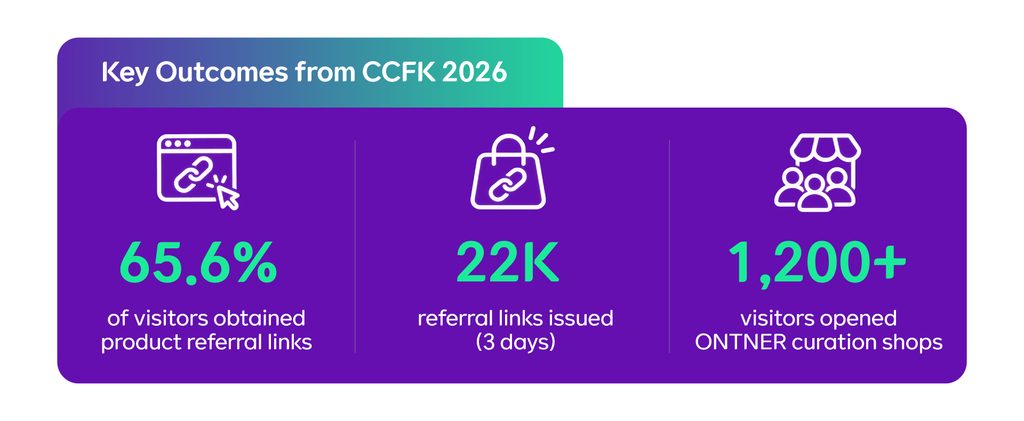
At the festival, visitors were able to scan QR codes at brand booths and receive referral links for products to recommend to their followers, enabling them to earn commissions on any purchases made through the links. In all, 65.6% of visitors took part, and about 22,000 links were issued over the three days. More than 1,200 of those who received links went on to set up their own “curation shops” on ONTNER, personal online storefronts that showcase products they have selected.
At the event, CJ ONSTYLE unveiled its growth strategy for content commerce. By 2030, it aims to grow creator commerce transaction volume to 35 times the level of 2025, the business’s first year, and to foster 100,000 creators specialized in commerce. The ultimate goal is to create a self-sustaining creator commerce ecosystem.
From Influence to Infrastructure
In the modern shopping era, creators have transformed from influencers who generate interest in products to commerce players who connect discovery with the decision to buy. As a result, the competitive edge in creator commerce now comes less from influence itself than from the ability to connect it to data, content and commerce infrastructure, turning it into repeatable transactions.

CJ ONSTYLE is building end-to-end commerce infrastructure to support the sustainable growth of creators and brands. The company is also applying its content commerce model to global consumers. In October, the company opened CJ ONSTYLE Global Mall, launching the service in the United States, Hong Kong and Singapore. The global approach mirrors the one used in Korea, in which content features products that celebrities and creators actually like and use, linking them directly to purchase.
Moving forward, the next step for creator commerce is to turn creators’ influence into sustainable commerce infrastructure and connect it to repeatable transactions and global growth.