This summary was generated with AI. We recommend reading the full article for accurate information.
From Korean dinner tables to North American grocery aisles, CJ Foods is expanding bibigo Rice through wider distribution and a campaign highlighting its versatility
Thirty Years In, Korea’s No. 1 Rice Goes Global
At a Korean table, rice is the center of the meal. No matter what else is served, a meal doesn’t feel complete without it. Nearly every household keeps a rice cooker, and for generations, rice was something made fresh each day. A bowl of glossy, just-steamed sticky rice is, to Koreans, the most basic component of a meal there is.
Hetbahn, CJ CheilJedang’s ready-to-serve rice, challenged that idea when it launched in 1996. At the time, buying rice already cooked struck many as odd. Thirty years on, it leads the ready-to-serve rice market in Korea.
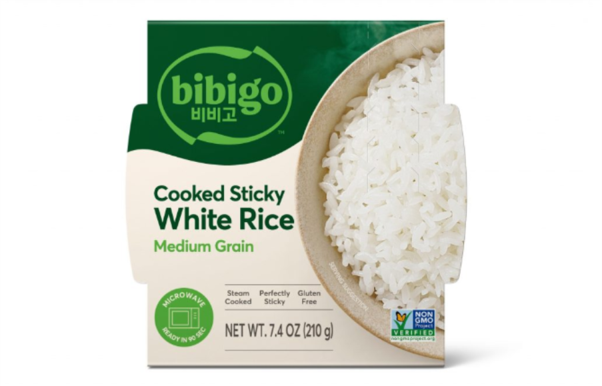
Its newest ground lies outside Korea. In the United States, the product is sold as bibigo Cooked Sticky White Rice — or bibigo Rice for short — and has nearly doubled its sales volume between 2021 and 2025.
How did Korea’s top microwavable rice build that foundation in North America?
Leading the Trend: Reading Demand Before It Arrived
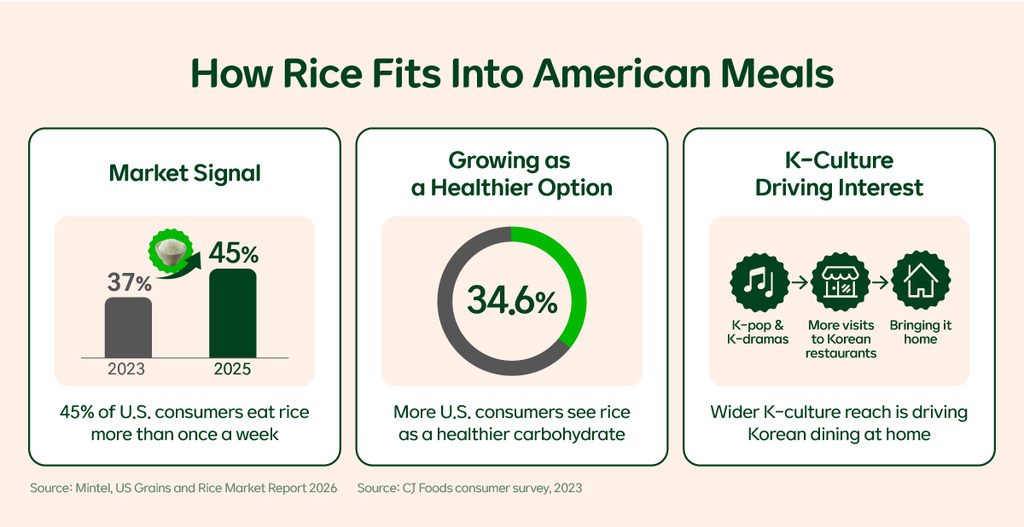
More Americans are eating rice more often. According to market research firm Mintel, the share of U.S. consumers eating rice more than once a week rose from 37% in 2023 to 45% in 2025. The research points to two key drivers: more cooking at home and growing curiosity about global cuisines.
The way that people view rice has shifted as well. As wellness habits reshape grocery lists, white rice is increasingly viewed as a healthier carbohydrate than bread or noodles. In a CJ Foods survey of North American consumers, 34.6% said they buy rice because they consider it a healthier option.
Adding to this momentum is the phenomenon of K-culture. As K-food exploded in popularity, thanks in part to its depiction in globally recognized K-dramas, Korean-style steamed rice naturally became more familiar to U.S. consumers as well. Diners who tasted Korean-style steamed rice at Korean restaurants began looking for the same comfort item at home.
Wanting rice and making it, however, are two different matters. Rice cookers are uncommon in American kitchens, and microwavable rice was already on North American shelves. But bibigo Rice stands out for several key reasons: it has the sticky texture of Korean-style rice, it’s ready in under two minutes and it’s shelf-stable for months. In a 2025 survey of U.S. consumers by CJ Schwan’s, more than 95% of North American consumers said they would buy it again.
Market Penetration: Meeting More Shoppers Where They Are
Building on this demand, CJ Foods expanded the product’s reach so shoppers could find it at more locations.
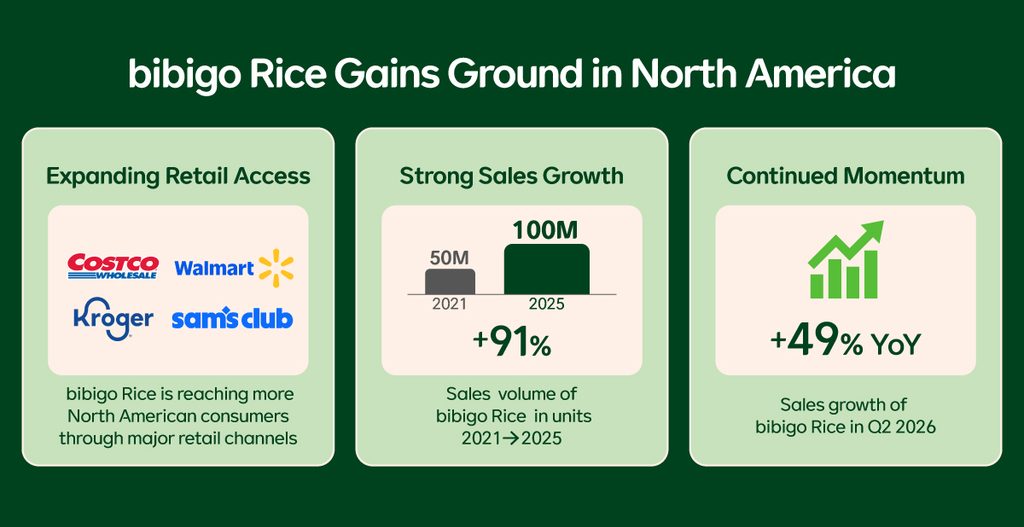
Distribution came first. bibigo Rice expanded from Asian grocers and moved into the aisles of large grocery chains where Americans shop each week, including Costco, Walmart and Kroger, before entering Sam’s Club last year.
Marketing followed. From August 31 to September 6 this year, CJ Foods ran ads for bibigo Rice on outdoor screens in Times Square, Broadway and downtown Los Angeles, proclaiming a single line: “Sticks to anything!” The copy plays on the product’s U.S. name while pointing to both its sticky texture and how easily it pairs with other food.
The online response was rapid. A teaser video posted to bibigo USA’s Instagram and TikTok accounts passed 20 million views within the first three weeks, and related Google searches more than tripled after the campaign began.
From the shelves of an Asian grocer to a building-wide screen in the middle of Times Square — that’s how far the range of American shoppers who encounter bibigo Rice has widened.
Sustained Growth: What the Numbers Show
The resulting numbers speak for themselves. U.S. sales of bibigo Rice grew from roughly 50 million units in 2021 to about 100 million last year, doubling in just four years.
Growth has continued throughout this year. Second-quarter sales in the Americas rose 49% year over year, while bibigo Mandu — Korean dumplings — grew 31%. Mandu was the first bibigo product introduced to the U.S. in 2010 and has anchored the business there ever since. The fact that bibigo Rice has already outpaced bibigo Mandu gives a sense of how quickly the category is growing.
CJ Foods is integrating microwavable rice into its next growth engine among K-food strategic products, after mandu. The question now is how far the ground gained in North America can extend.
Toward the World’s Everyday Rice
The answer to the question of bibigo Rice’s growth is written into the campaign. “Sticks to anything!” does more than build awareness — it shows where bibigo Rice is headed: from a side dish served with Korean food to an everyday staple eaten alongside local cooking. That direction played out across two phases of campaign videos released on social media.
The first phase placed bibigo Rice beside samgyeopsal, bibimbap, tofu kimchi and japchae — iconic Korean dishes in which rice is the foundation of the meal, and the starting point for anyone exploring Korean food.
The second phase paired bibigo Rice with steak, burrito bowls and mac and cheese — relaying the message that Korean rice belongs not only next to Korean dishes but on tables worldwide.

bibigo Rice already sells in more than 60 markets including the U.S., Australia and Mexico. CJ Foods is growing the product beyond the frame of “Korean-style microwavable rice” into a global food that works well with many cuisines — with the larger goal, built on the ground gained in North America, of making it a default choice wherever rice is served.
Thirty Years In: The Next Wave of K-Food
Thirty years ago, Hetbahn changed how Koreans eat rice. It changed from a dish that had to be made fresh each day to something that could simply be bought and easily made.
Now what’s changing is where that rice belongs. Korean-style sticky rice has found its way onto American tables, moving from a companion of Korean dishes to a bowl served with steak or mac and cheese. Built on the ground gained in North America, the aim is to become a default choice wherever rice is served.
A single bowl of rice, traveling from Korean tables to tables around the world — that is the next wave of K-food that CJ Foods is working toward.