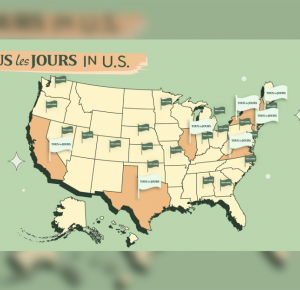
For more than two decades, TOUS les JOURS has been bringing Korean bakery culture abroad — largely retaining its products, in-store experience and its brand identity rather than adapting them to local tastes. The company calls this approach “K-ness,” which it says has helped expand the brand’s U.S. footprint to 205 stores, with a target of 1,000 by 2030
At a Glance
- TOUS les JOURS calls its approach “K-ness” — maintaining its Korean products and the in-store experience in the U.S., rather than adapting them to local tastes.
- Since opening its first U.S. store in 2004, the brand has grown to 205 locations as of June 2026.
- Last year, the company opened its first U.S. production facility, in Georgia — the first U.S. manufacturing facility established by a Korean bakery company.
- The brand has also extended this identity beyond its stores, through new product launches, partnerships with global IP and appearances at cultural events.
“Localization isn’t about changing the taste. It’s about recreating the same taste with different ingredients and materials. K-ness is our differentiator.”
— Seungjun Ahn, Head of U.S. Business, TOUS les JOURS
For Ahn, localization has a different meaning from the conventional idea of adapting to a new market. It isn’t about adjusting a product to fit local tastes — it’s about recreating that same taste with ingredients available locally. TOUS les JOURS calls this approach “K-ness,” and it runs deeper than the recipe. It shows up in how the product is made, how customers shop in the store and how the brand shows up outside it.
TOUS les JOURS opened its first U.S. store in 2004. As of June 2026, it operates 205 locations. Over that time, the brand has moved from a novelty destination to a neighborhood bakery with a growing U.S. presence. This is how staying rooted in its Korean identity, rather than extensively adapting to local tastes, made that possible.
Why K-Bakery Resonates with U.S. Consumers
The case at a TOUS les JOURS in the U.S. looks much like it does in Korea. From the products on the shelf to the way customers shop, the bakery has retained much of its original identity in the American market, making that authenticity a key point of differentiation.
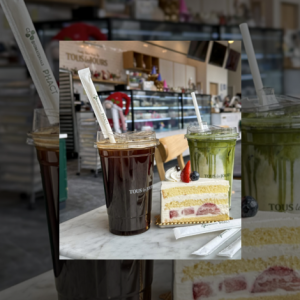
The product lineup reflects this. Kimchi croquettes, twist doughnuts, salt & butter rolls and rich milk cream bread are all on the shelf. The drink menu is similar: alongside standard coffee, stores sell ube lattes, currently popular in Korea. The brand hasn’t selected just a few hit products for export. It has brought much of the Korean store menu to the U.S.

One product in particular stands out: the Cloud Cake. Made with lightly sweetened cream, the cake is common in Korea but stands out in a market where denser butter cakes are more familiar. Customers describe its texture as “cloudy” and treat it as a premium item. It costs more than a standard butter cake but continues to sell well.
The in-store experience follows the same pattern. TOUS les JOURS uses a self-service format: rather than having staff retrieve products, shoppers browse the selection and choose their own items with a tray and tongs — the same way they would in Korea. And while many local bakeries in the U.S. carry a narrow selection, TOUS les JOURS lays out a wide range of freshly baked items from early morning — a “total bakery” format that remains uncommon in the U.S. market.
About 72% of visitors recognize TOUS les JOURS as a Korean bakery — and that awareness has become one of the reasons customers choose to visit, rather than something the brand needs to work around.
How K-ness Survives Franchising
Maintaining this identity in one or two flagship stores is one thing. Reproducing it across hundreds of locations is another. More than 90% of TOUS les JOURS’ U.S. stores are franchises. If products or service varied from store to store, the brand experience the company has built could start to erode.
TOUS les JOURS manages this through a system that applies across its entire franchise network. New franchisees complete standardized training covering product preparation, store operations and customer service. Store design and merchandising follow separate guidelines as well.
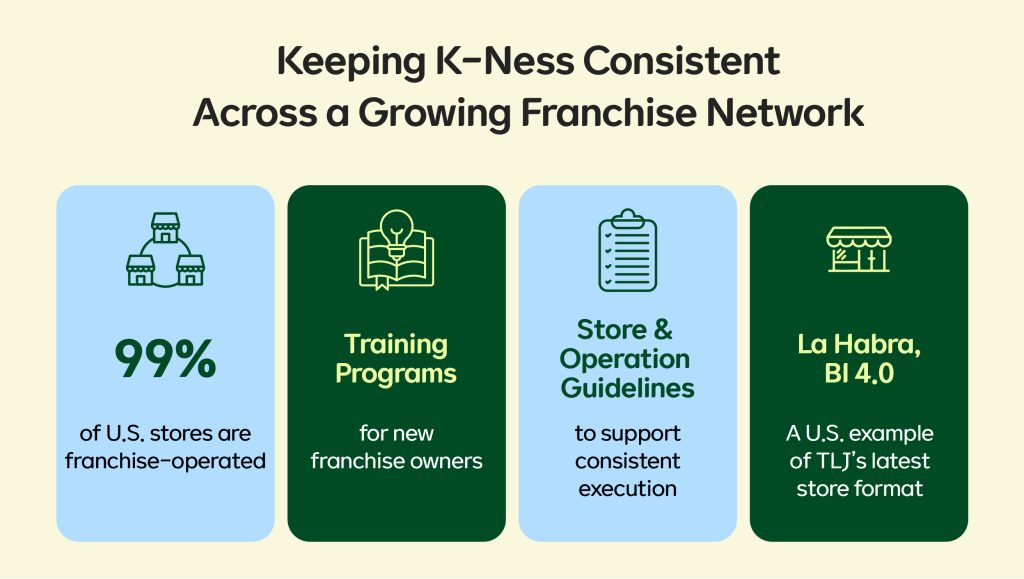
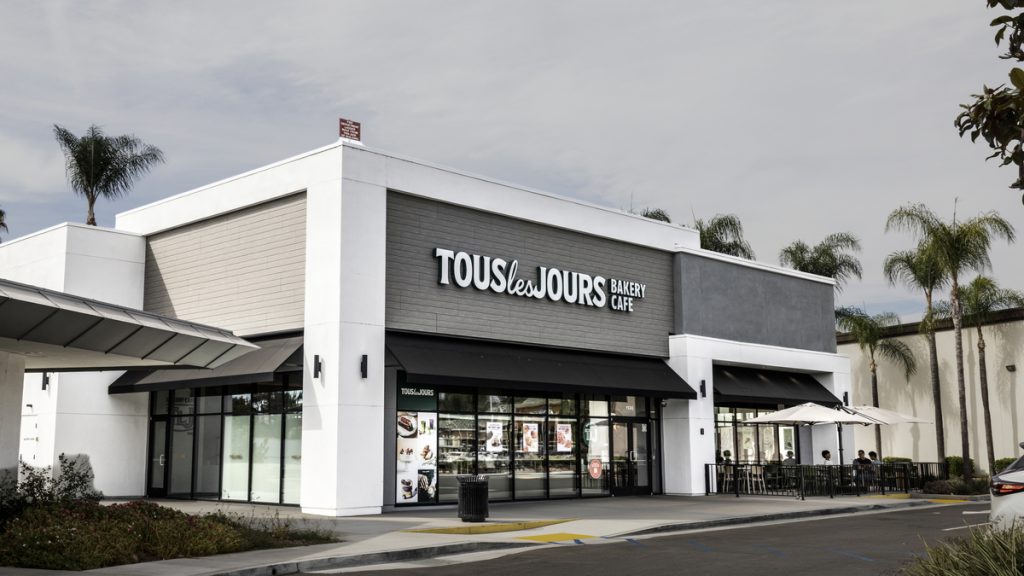
This system is most visible at the La Habra location in California. The store was the first in North America to adopt “BI 4.0,” the latest store design used at flagship locations such as Apgujeong and Gangnam in Seoul. La Habra functions as more than a company-owned store — it serves as a model location for the brand’s U.S. franchise expansion, where new owners can see firsthand how the store is meant to operate: how products are displayed, how staff interact with customers and how daily operations work. Keeping the product and experience consistent as the chain grows depends on an operating system that can reproduce what TOUS les JOURS built in Korea, store by store.
How K-ness Stays Visible
K-ness doesn’t stop at the store’s front door. TOUS les JOURS extends this identity through new products, partnerships with global IP and cultural events.
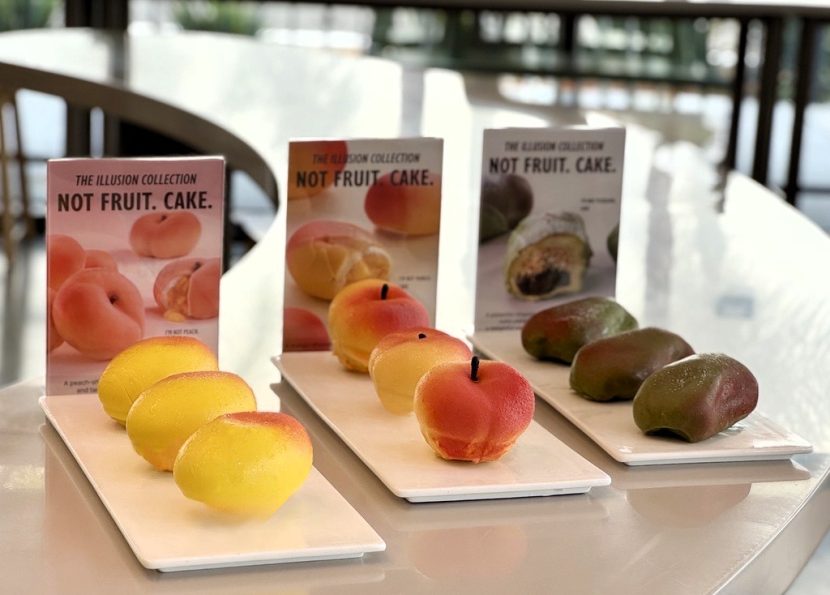
Start with the product. AGJAK, a cake that drew long lines and sold out repeatedly in Korea, launched at three West Coast flagship stores — La Habra, Cerritos and Brea — in August. Shaped to resemble peaches or mangoes but revealing a soft mousse filling inside, it debuted in the U.S. as the “NOT FRUIT. CAKE” series, with playful individual names such as “I’m Not Peach. Cake.” The recipe and manufacturing process remain identical to the Korean original. It also shows how quickly TOUS les JOURS brings new Korean products to the U.S., keeping its offerings current with what’s popular back home.
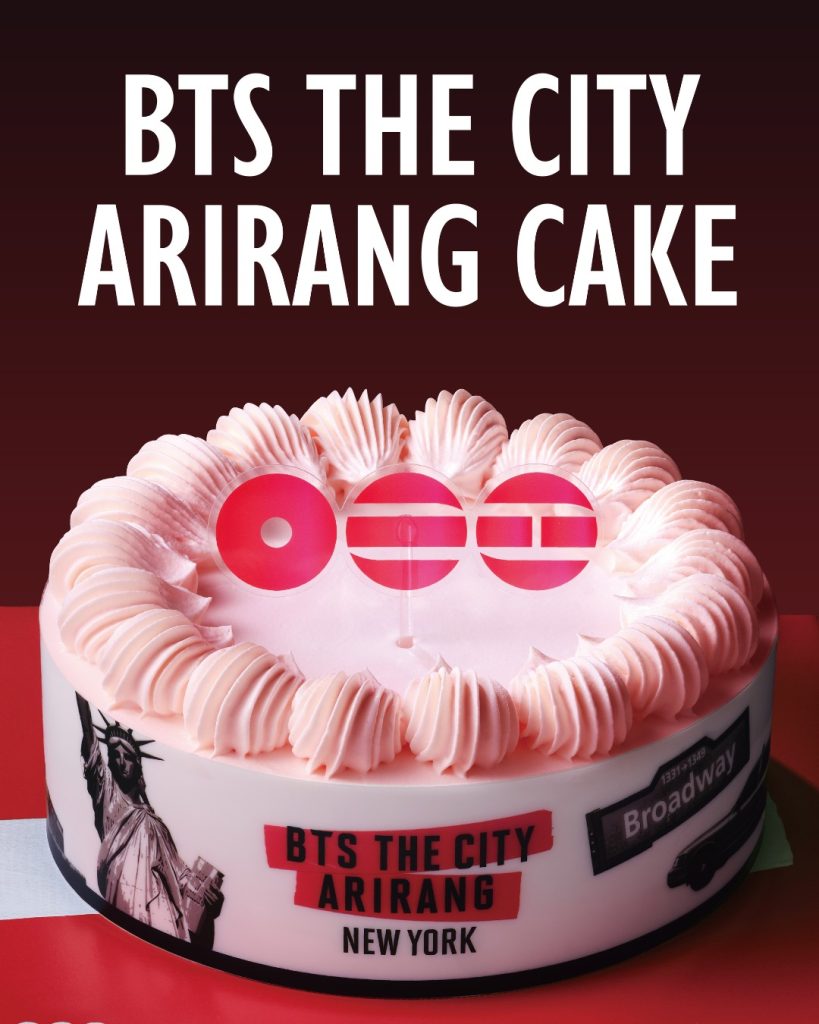
Next is the brand’s work with global IP. TOUS les JOURS served as the official bakery café sponsor of BTS THE CITY ARIRANG, first in Las Vegas in June, then in New York from late July through early August. Four New York-area cafés were transformed into fan spaces for the event, featuring a limited-edition BTS-themed cake and other exclusive menu items. As interest in K-pop continues to grow worldwide, the partnership was designed to let fans gathered for the event experience Korean bakery hospitality alongside the music. Through it, TOUS les JOURS reached not only local shoppers but the global audience drawn to BTS THE CITY ARIRANG.
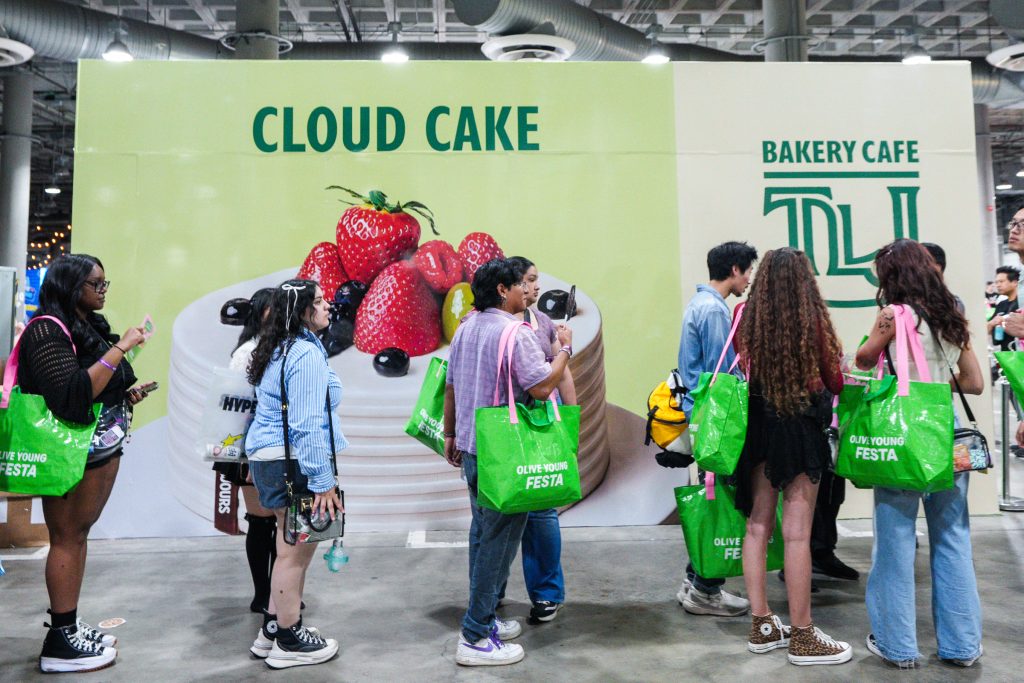
Third is CJ’s own cultural platforms. TOUS les JOURS ran experiential booths at THE CJ CUP Byron Nelson golf tournament in Texas in May and at KCON LA 2026 in August. The two events drew different crowds, but the brand experience was consistent — each booth centered on the Cloud Cake as a hands-on, photo-worthy centerpiece, backed by tastings and branded activities that let visitors experience the product directly. At THE CJ CUP, the audience was golf spectators; at KCON, K-pop fans. These events introduced K-bakery to consumers with different interests, extending the brand’s reach beyond its stores.
Eight Years of Profit, and Building Toward 1,000
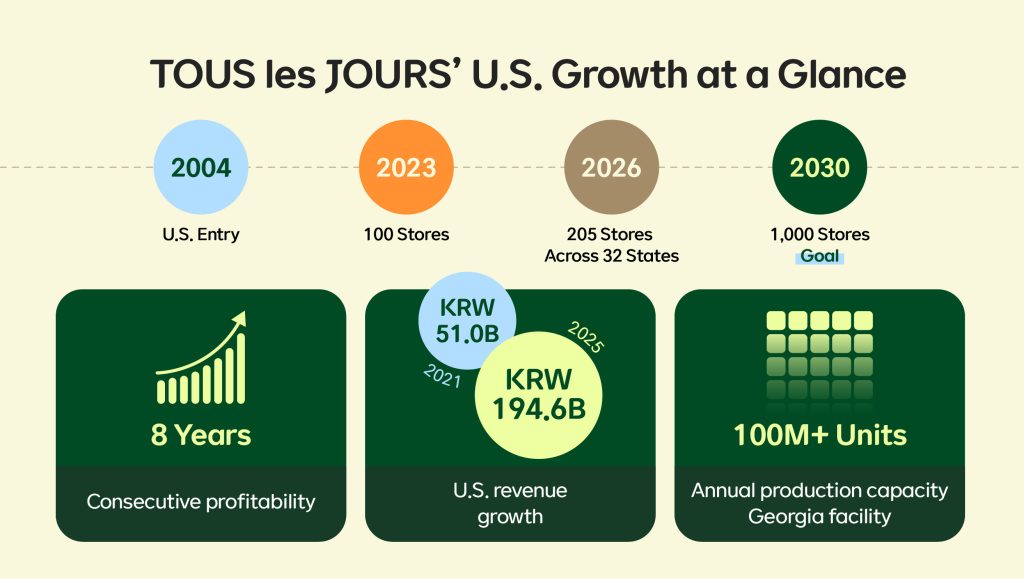
TOUS les JOURS opened its first U.S. store in 2004. As of June 2026, it operates 205 locations. The U.S. subsidiary has posted eight consecutive years of net profit since 2018, and revenue has grown roughly fourfold over four years — from 51 billion KRW (36.9 million USD) in 2021 to 194.6 billion KRW (140.8 million USD) in 2025.
Supporting this growth requires expanding production and operations. TOUS les JOURS opened a production facility in Gainesville, Georgia, late last year — the first U.S. manufacturing plant built by a Korean bakery company. The roughly 90,000-square-meter facility can produce more than 100 million units annually, including frozen dough and cakes. It provides franchisees with a stable product source while lowering tariff costs to support competitive pricing.
Franchise operations are scaling accordingly. More than half of all franchisees now operate two or more locations. Against that backdrop, TOUS les JOURS has expanded from the East and West Coasts into the Midwest and Hawaii, accelerating the pace of franchise growth nationwide.
More than 200 prospective franchisees are currently waiting for a location of their own — a sign of continued interest in the franchise model. Building on that, TOUS les JOURS has set a target of 1,000 stores by 2030.
The TOUS les JOURS case suggests that growing abroad doesn’t always require becoming local. The company has maintained Korean products and store experiences as its main point of differentiation, while building a franchise system that reproduces that experience consistently and extending its reach beyond stores through new products, partnerships and cultural events. A local production base now supports further expansion.
The goal of 1,000 stores by 2030 is not a move away from that identity. It’s the next step in applying the same approach — K-ness — consistently across a larger number of stores and a wider footprint in the U.S.