This summary was generated with AI. We recommend reading the full article for accurate information.
CJ’s December 2025 global survey indicates that the K-wave continued expanding in 2025, with 75% of respondents expressing interest and 53% reporting purchases of Korean products or services. K-culture increasingly functions as a broader lifestyle connecting content, food, beauty, fashion and other experiences.
Examples from KCON, THE CJ CUP Byron Nelson and OLIVE YOUNG show how exposure to Korean content can lead to spending across multiple industries. The article presents this interconnected “K-ecosystem” as a growing global market, including tourism experiences centered on Korean everyday life.
This article examines where the K-wave stands today against the data. Drawing on the CJ Global K-wave Consumer Survey (December 2025; 7,100 respondents aged 15 to 49 across 12 countries) and on-the-ground cases from CJ ENM’s KCON, THE CJ CUP Byron Nelson and OLIVE YOUNG, it traces how the experience of K-content carries over into K-food and K-beauty spending.
“Has the K-Wave Passed Its Peak?”
The short answer is no — not yet. According to the CJ Global K-wave Consumer Survey (December 2025; 7,100 respondents aged 15 to 49 across 12 countries), interest in and experience with the K-wave both rose meaningfully in 2025 from the year before, which points to a wave that is still spreading. Contrary to some of the talk that ‘the K-wave has peaked,’ the influence of ‘K’ in the actual market is widening past a handful of countries to the world as a whole.
What is ‘K’
So what does ‘K’ mean to consumers around the world?
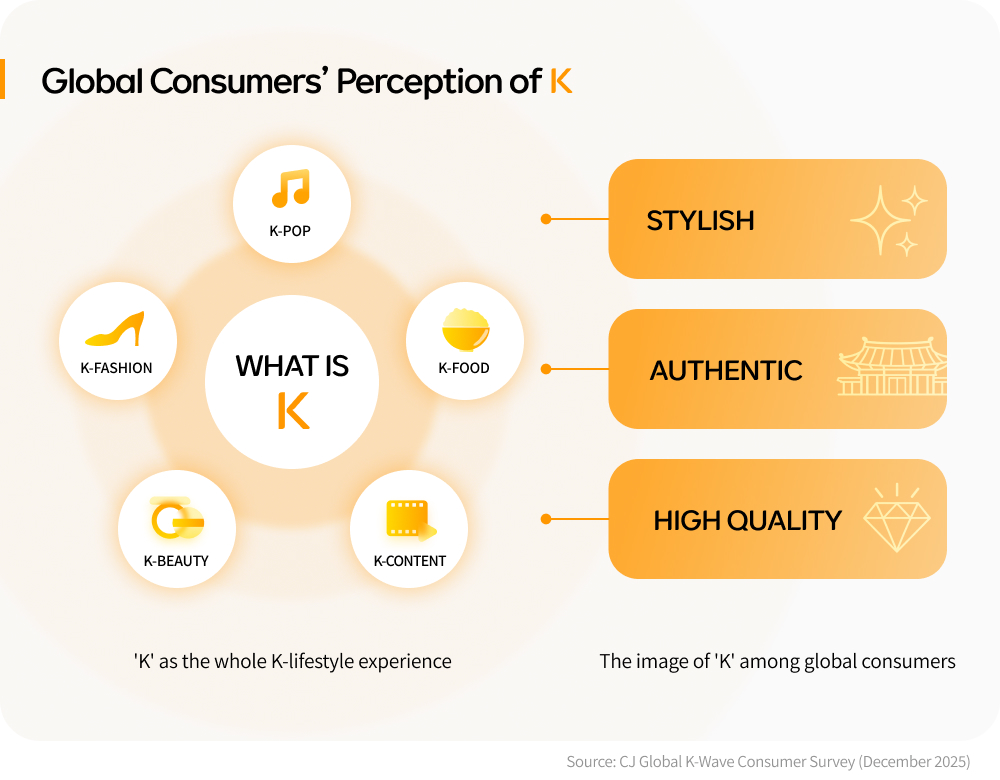
Only ten years ago, K-culture was something a small group took part in, listening to K-pop or watching Korean dramas. Today K-culture reaches past K-pop, K-food and K-content to K-beauty and K-fashion, covering every form of daily life that Koreans eat, listen to, watch and wear — in other words, the whole experience of the ‘K-lifestyle.’
As a result, consumers around the world tie ‘K’ directly to a positive set of associations: ‘Stylish,’ ‘Authentic’ and ‘High Quality.’ Among younger consumers in particular, K-culture is no longer a culture for the few. It has settled in as a ‘popular and mainstream’ one.
The K-Lifestyle, Expanding From Trend to Everyday Life
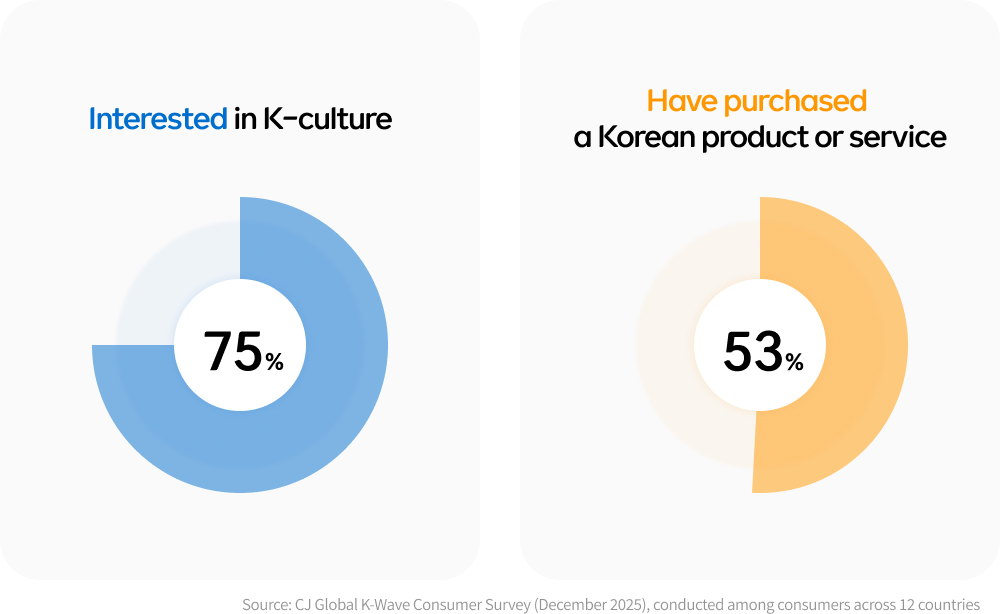
The global influence of the K-lifestyle shows up in the data as well. In the CJ Global K-wave Consumer Survey (December 2025), 75% of consumers across the 12 countries said they were interested in the K-wave as of 2025, and 53% said they had bought a Korean product or service themselves. It is a sign that K-culture is carrying past simple content consumption into real experience.
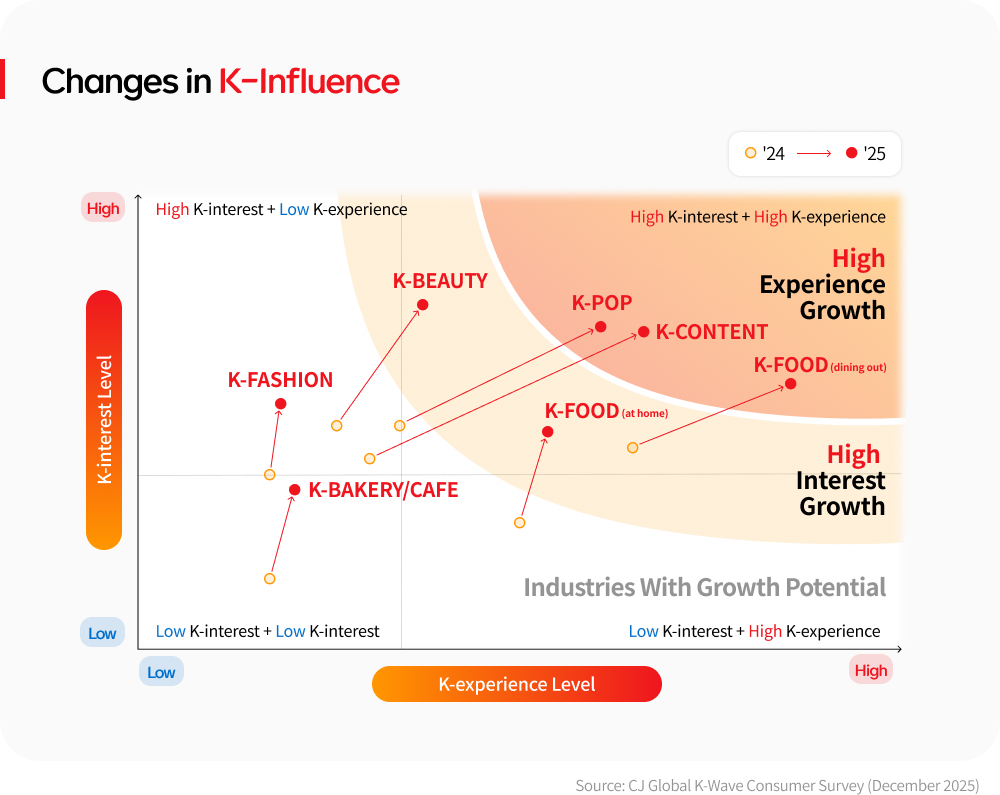
Growth stages differ by industry. Helped by ‘KPop Demon Hunters,’ which drew worldwide attention in 2025, K-content, K-pop and Korean dining out showed pronounced experience-driven growth, while K-beauty and K-fashion saw interest climb quickly and are counted among the fields with the most growth potential ahead.
Spending on Korean products and services, in particular, does not stay within a single industry. In the same survey, 79% of consumers around the world had experienced two or more K industries at once, which shows that rather than growing independently, these industries form a ‘K-ecosystem’ — K-pop and K-dramas leading into K-food and K-beauty and on to K-fashion — that is at work inside actual consumption data.
Figure 1. “A chart plotting each industry’s position by K interest (vertical axis) and K experience (horizontal axis), with arrows showing the shift from 2024 to 2025. All seven industries — K-pop, K-content, K-food (dining out), K-food (at home), K-beauty, K-fashion and K-bakery/cafe — rose in both interest and experience from the previous year. Source: CJ Global K-Wave Consumer Survey (December 2025).”
The K-Ecosystem, With CJ at the Center of the Experience
CJ ENM’s KCON, a K-culture festival reaching across Asia, North America, the Middle East and the world
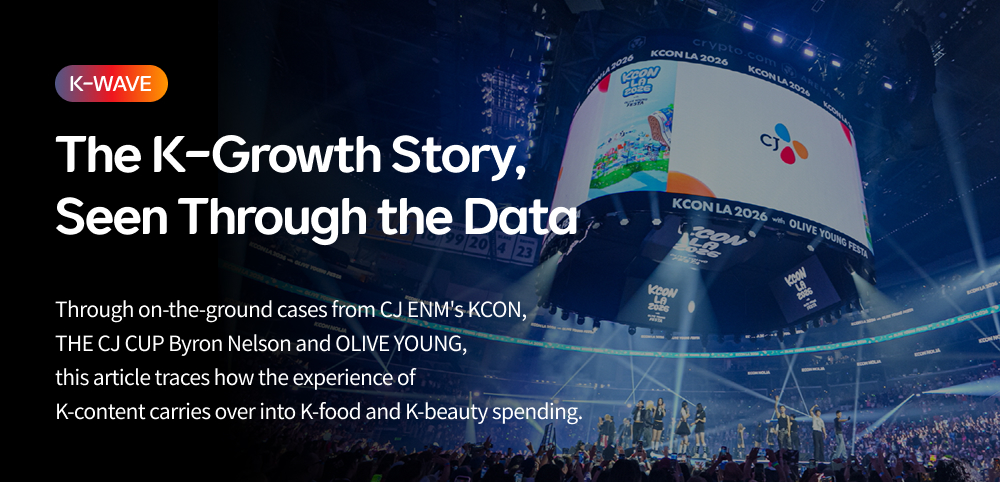
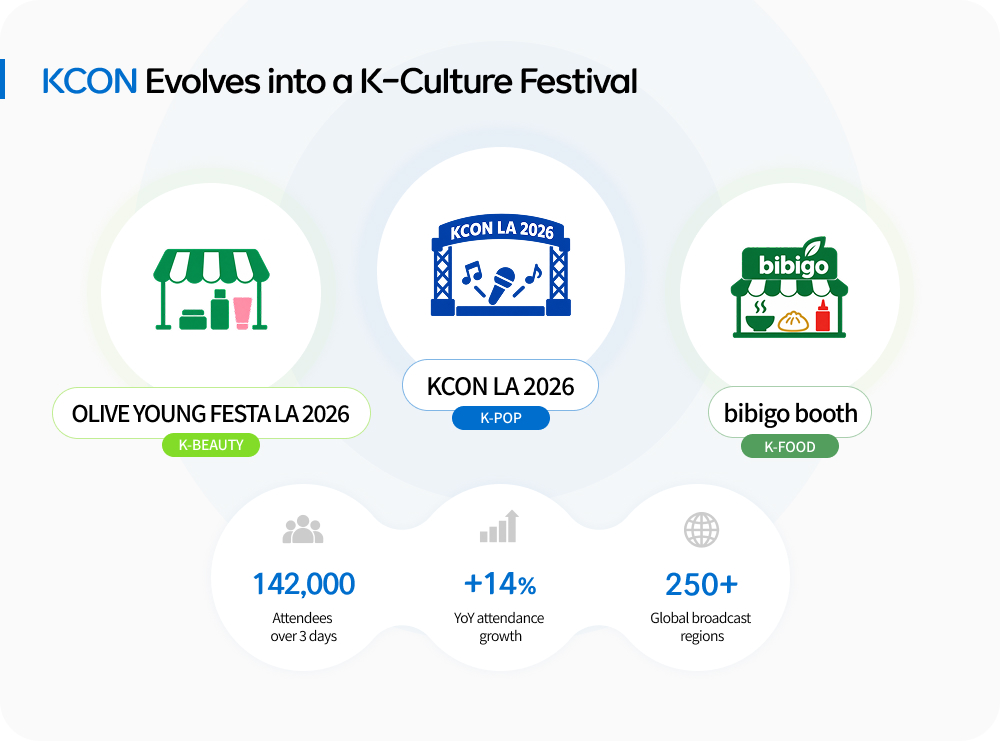
KCON, which CJ ENM first launched in the United States in 2012, has since expanded to New York, Tokyo, Bangkok, Abu Dhabi and beyond, drawing crowds along the way. KCON LA 2026 set an all-time attendance record with 142,000 people over three days (CJ ENM announcement; up about 14% from 125,000 the year before) and was broadcast simultaneously to more than 250 regions worldwide. In 2026 in particular, OLIVE YOUNG FESTA LA 2026 joined KCON for the first time in the United States, recreating Seoul’s best-known shopping districts including Seongsu, Gangnam, Hongdae and Myeongdong, while the CJ Foods bibigo booth next to the venue presented ramyeon, dumplings, sauces, seaweed and more. Past the K-pop concert and on to K-beauty and K-food, the experience has expanded across the K-lifestyle as a whole.
THE CJ CUP Byron Nelson, Meeting the K-Lifestyle at a Sporting Event
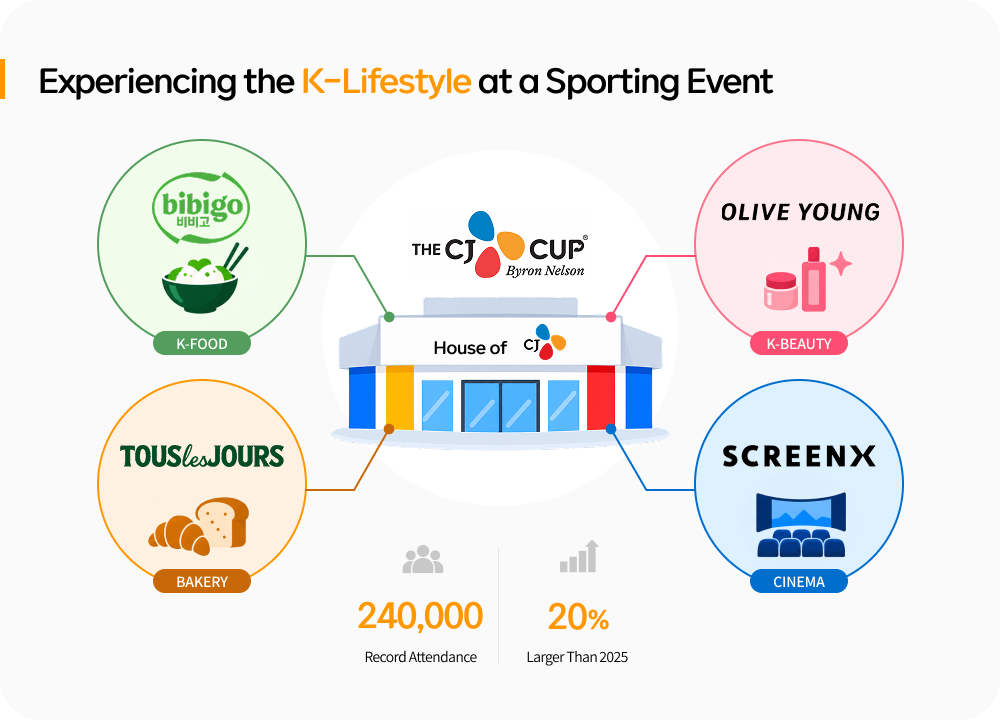
THE CJ CUP is a full-field event on the PGA TOUR’s regular season that CJ Group has title-sponsored for ten years since its launch in 2017, and the 2026 tournament set a tournament attendance record with a gallery of 240,000 over four days (CJ Group announcement). At the 2026 tournament, major CJ brands gathered in one space at HOUSE OF CJ among them CJ Foods’ bibigo, OLIVE YOUNG, CJ Foodville’s TOUS les JOURS and CJ CGV’s SCREENX. HOUSE OF CJ is the group’s integrated experience pavilion, which CJ Group first operated at THE CJ CUP in 2025; for 2026 it was built out to roughly 750 square meters, 20% larger than the year before (CJ Group announcement). Visitors, by many accounts, took in the whole of the K-lifestyle in condensed form along a single day’s path of ‘eating, applying and resting.’
‘K-Dailycation’ Goes Nationwide: The Tourism Map OLIVE YOUNG is drawing
‘K-dailycation,’ meaning the experience of everyday life in Korea, is spreading across the country with OLIVE YOUNG at the center. OLIVE YOUNG’s sales to international customers passed 1 trillion KRW at its offline stores in Korea from January through August 2026 (OLIVE YOUNG announcement, August 31, 2026).
What produced 1 trillion KRW in sales to international customers is not simply the number of stores but a strategy that designed each region’s distinct daily life as content. Along with the ‘Gwangjang Market store’ opened at Gwangjang Market in Seoul (opened April 30, 2026), the company introduced region-specific stores at major tourist destinations outside the capital area and opened the wallets of international visitors. At the Gwangjang Market store, more than 80% of sales from opening through July 31 came from international customers visiting Korea (OLIVE YOUNG tally). More recently it has paired regional specialties with character IP, distributing limited-edition goods built around local foods such as Gongju chestnuts, Busan fish cake and Jeonju bibimbap to stores nationwide, and bringing out a ‘hanbok Hello Kitty’ in districts central to international visitors such as Gyeongju and Anguk. The result is that OLIVE YOUNG is drawing a nationwide K-dailycation map that travelers run into wherever they go.
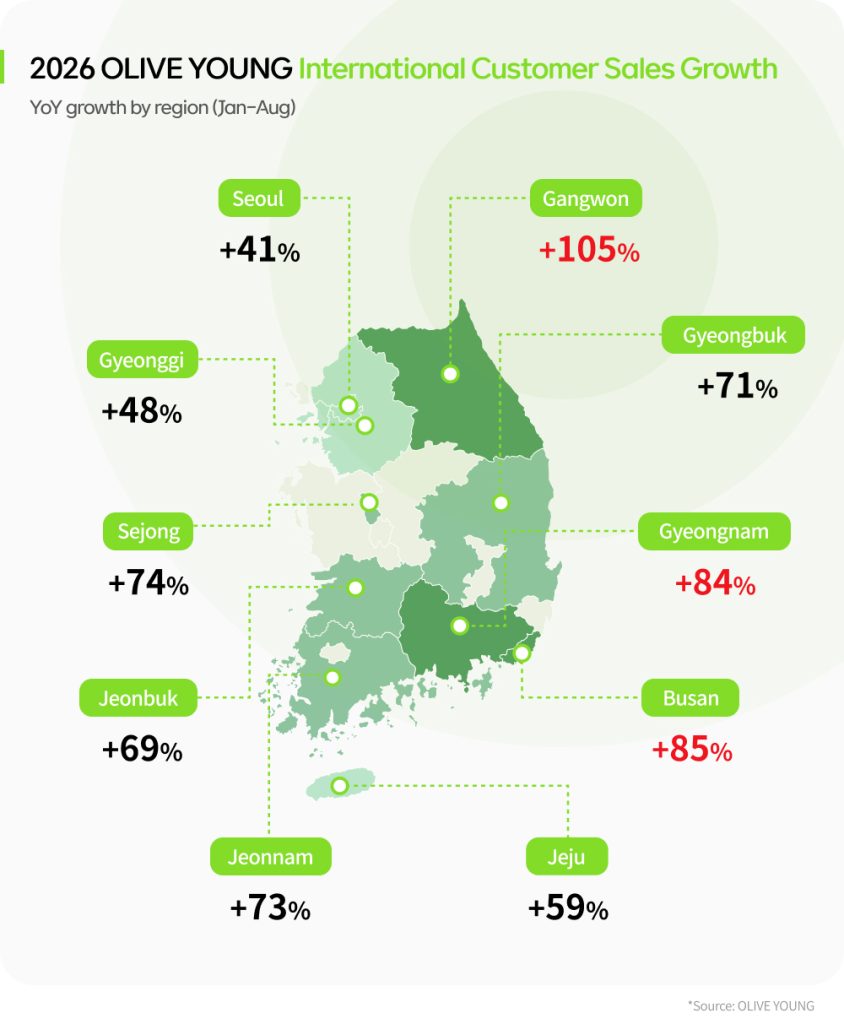
Figure 2: “A map of OLIVE YOUNG’s growth in sales to international customers by region, January to August 2026. Gangwon 105%, Busan 85%, Gyeongnam 84%, Sejong 74%, Jeonnam 73%, Gyeongbuk 71%, Jeonbuk 69%, Jeju 59%, Gyeonggi 48%, Seoul 41%. Source: OLIVE YOUNG.”
Table 2. Growth in OLIVE YOUNG’s sales to international customers by region, January to August 2026 (year over year)
(Courtesy of OLIVE YOUNG, based on the announcement of August 31, 2026. National average +47%)
Region
Growth
Region
Growth
Seoul
+41%
Gyeongnam
+84%
Gyeonggi
+48%
Busan
+85%
Gangwon
+105%
Jeonbuk
+69%
Sejong
+74%
Jeonnam
+73%
Gyeongbuk
+71%
Jeju
+59%
The K-Wave Keeps Growing. Where Does It Go From Here?
The conversion effect in which K-content carries over into K-food and K-beauty spending has already been confirmed both in the data and in the field. As the the K-wave continues to expand, CJ is well positioned to connect food, beauty, content and pop music as one.
With the wave rising now, the question worth watching is what the K-Wave turns into next.
Key Takeaways
The K-Wave has not passed its peak. In the CJ Global K-Wave Consumer Survey (December 2025; 7,100 respondents aged 15 to 49 across 12 countries), interest in and experience with the K-wave rose meaningfully in 2025 from the year before.
Interest is carrying over into actual purchases. In the same survey, 75% of consumers across the 12 countries were interested in the K-wave as of 2025, and 53% had bought a Korean product or service themselves.
‘K’ is no longer a genre. It has become a lifestyle. Past K-pop, K-food and K-content and on to K-beauty and K-fashion, ‘K’ means daily life as a whole — what Koreans eat, listen to, watch and wear — and it is tied directly to a Stylish, Authentic, High Quality image.
Growth stages differ by industry. In the same survey, K-content, K-pop and Korean dining out showed pronounced experience-driven growth, while K-beauty and K-fashion saw interest climb quickly and hold large growth potential ahead.
The K-ecosystem is actually at work inside the data. In the same survey, 79% of consumers around the world had experienced two or more K industries at once, confirming the flow that runs from K-pop and K-dramas into K-food, K-beauty and K-fashion.
CJ ENM’s KCON has become a stage for experiencing the K-lifestyle as a whole. KCON LA 2026 set an all-time record with 142,000 attendees over three days (CJ ENM announcement; up about 14% year over year) and was broadcast simultaneously to more than 250 regions. In 2026, OLIVE YOUNG FESTA LA 2026 and the CJ Foods bibigo booth joined it.
International visitors come to Korea to buy ‘the everyday life of Koreans.’ At the OLIVE YOUNG Gwangjang Market store, which opened on April 30, 2026, more than 80% of sales in its first three months (through July 31) came from international customers visiting Korea (OLIVE YOUNG tally). It is an inbound case of the K-ecosystem aimed at ‘K-dailycation.’
Frequently Asked Questions
A. It has not passed its peak yet. In the CJ Global K-Wave Consumer Survey (December 2025; 7,100 respondents aged 15 to 49 across 12 countries), interest in and experience with the K-wave rose meaningfully in 2025 from the year before. As of 2025, 75% of consumers across the 12 countries were interested in the K-wave and 53% had bought a Korean product or service themselves. In the actual market, the influence of K is widening past a handful of countries to the world as a whole.
A. To consumers around the world, ‘K’ means the whole experience of the ‘K-lifestyle,’ reaching past K-pop, K-food and K-content to take in K-beauty and K-fashion. Ten years ago K-culture was the culture of a small group who listened to K-pop or watched Korean dramas, but today it points to every form of daily life that Koreans eat, listen to, watch and wear. For consumers around the world, ‘K’ is tied directly to a ‘Stylish,’ ‘Authentic’ and ‘High Quality’ image, and for younger consumers it has settled in as a ‘popular and mainstream’ culture.
A. The K-ecosystem means a structure in which K industries do not grow independently but instead carry consumption from one to another. In the CJ Global K-Wave Consumer Survey (December 2025; 7,100 respondents aged 15 to 49 across 12 countries), 79% of consumers around the world had experienced two or more K industries at once. The flow that runs from K-pop and K-dramas into K-food and K-beauty, and on to K-fashion, is at work inside actual consumption data.
A. KCON is a K-culture festival that CJ ENM first launched in the United States in 2012 and has since expanded to New York, Tokyo, Bangkok, Abu Dhabi and beyond. KCON LA 2026 set an all-time attendance record with 142,000 people over three days (CJ ENM announcement; up about 14% year over year) and was broadcast simultaneously to more than 250 regions worldwide. In 2026, OLIVE YOUNG FESTA LA 2026 joined KCON for the first time in the United States, recreating Seoul’s best-known shopping districts including Seongsu, Gangnam, Hongdae and Myeongdong, while the CJ Foods bibigo booth next to the venue presented ramyeon, dumplings, sauces, seaweed and more.
A. HOUSE OF CJ is the group’s integrated experience pavilion that CJ Group operates at the venue of THE CJ CUP Byron Nelson, a PGA TOUR event. It was first operated at the 2025 tournament, and at the 2026 tournament it was built out to roughly 750 square meters, 20% larger than the year before, gathering major CJ brands in one space, among them CJ Foods’ bibigo, OLIVE YOUNG, CJ Foodville’s TOUS les JOURS and CJ CGV’s SCREENX. The 2026 tournament drew a gallery of 240,000 over four days, setting a tournament attendance record (CJ Group announcement).
A. K-dailycation means the trend of international visitors to Korea experiencing the everyday culture of Koreans exactly as it is. The OLIVE YOUNG Gwangjang Market store, which opened at Gwangjang Market in Seoul on April 30, 2026, is a case aimed squarely at this flow. Reaching past established districts such as Myeongdong, Seongsu and Hongdae, it brought K-beauty into the space of a traditional market, and more than 80% of sales in its first three months (through July 31) came from international customers who visited Korea (OLIVE YOUNG tally).
This article examines where the K-wave stands today against the data. Drawing on the CJ Global K-wave Consumer Survey (December 2025; 7,100 respondents aged 15 to 49 across 12 countries) and on-the-ground cases from CJ ENM’s KCON, THE CJ CUP Byron Nelson and OLIVE YOUNG, it traces how the experience of K-content carries over into K-food and K-beauty spending.
“Has the K-Wave Passed Its Peak?”
The short answer is no — not yet. According to the CJ Global K-wave Consumer Survey (December 2025; 7,100 respondents aged 15 to 49 across 12 countries), interest in and experience with the K-wave both rose meaningfully in 2025 from the year before, which points to a wave that is still spreading. Contrary to some of the talk that ‘the K-wave has peaked,’ the influence of ‘K’ in the actual market is widening past a handful of countries to the world as a whole.
What is ‘K’
So what does ‘K’ mean to consumers around the world?
Only ten years ago, K-culture was something a small group took part in, listening to K-pop or watching Korean dramas. Today K-culture reaches past K-pop, K-food and K-content to K-beauty and K-fashion, covering every form of daily life that Koreans eat, listen to, watch and wear — in other words, the whole experience of the ‘K-lifestyle.’
As a result, consumers around the world tie ‘K’ directly to a positive set of associations: ‘Stylish,’ ‘Authentic’ and ‘High Quality.’ Among younger consumers in particular, K-culture is no longer a culture for the few. It has settled in as a ‘popular and mainstream’ one.
The K-Lifestyle, Expanding From Trend to Everyday Life
The global influence of the K-lifestyle shows up in the data as well. In the CJ Global K-wave Consumer Survey (December 2025), 75% of consumers across the 12 countries said they were interested in the K-wave as of 2025, and 53% said they had bought a Korean product or service themselves. It is a sign that K-culture is carrying past simple content consumption into real experience.
Growth stages differ by industry. Helped by ‘KPop Demon Hunters,’ which drew worldwide attention in 2025, K-content, K-pop and Korean dining out showed pronounced experience-driven growth, while K-beauty and K-fashion saw interest climb quickly and are counted among the fields with the most growth potential ahead.
Spending on Korean products and services, in particular, does not stay within a single industry. In the same survey, 79% of consumers around the world had experienced two or more K industries at once, which shows that rather than growing independently, these industries form a ‘K-ecosystem’ — K-pop and K-dramas leading into K-food and K-beauty and on to K-fashion — that is at work inside actual consumption data.
Figure 1. “A chart plotting each industry’s position by K interest (vertical axis) and K experience (horizontal axis), with arrows showing the shift from 2024 to 2025. All seven industries — K-pop, K-content, K-food (dining out), K-food (at home), K-beauty, K-fashion and K-bakery/cafe — rose in both interest and experience from the previous year. Source: CJ Global K-Wave Consumer Survey (December 2025).”
The K-Ecosystem, With CJ at the Center of the Experience
CJ ENM’s KCON, a K-culture festival reaching across Asia, North America, the Middle East and the world
KCON, which CJ ENM first launched in the United States in 2012, has since expanded to New York, Tokyo, Bangkok, Abu Dhabi and beyond, drawing crowds along the way. KCON LA 2026 set an all-time attendance record with 142,000 people over three days (CJ ENM announcement; up about 14% from 125,000 the year before) and was broadcast simultaneously to more than 250 regions worldwide. In 2026 in particular, OLIVE YOUNG FESTA LA 2026 joined KCON for the first time in the United States, recreating Seoul’s best-known shopping districts including Seongsu, Gangnam, Hongdae and Myeongdong, while the CJ Foods bibigo booth next to the venue presented ramyeon, dumplings, sauces, seaweed and more. Past the K-pop concert and on to K-beauty and K-food, the experience has expanded across the K-lifestyle as a whole.
THE CJ CUP Byron Nelson, Meeting the K-Lifestyle at a Sporting Event
THE CJ CUP is a full-field event on the PGA TOUR’s regular season that CJ Group has title-sponsored for ten years since its launch in 2017, and the 2026 tournament set a tournament attendance record with a gallery of 240,000 over four days (CJ Group announcement). At the 2026 tournament, major CJ brands gathered in one space at HOUSE OF CJ among them CJ Foods’ bibigo, OLIVE YOUNG, CJ Foodville’s TOUS les JOURS and CJ CGV’s SCREENX. HOUSE OF CJ is the group’s integrated experience pavilion, which CJ Group first operated at THE CJ CUP in 2025; for 2026 it was built out to roughly 750 square meters, 20% larger than the year before (CJ Group announcement). Visitors, by many accounts, took in the whole of the K-lifestyle in condensed form along a single day’s path of ‘eating, applying and resting.’
‘K-Dailycation’ Goes Nationwide: The Tourism Map OLIVE YOUNG is drawing
‘K-dailycation,’ meaning the experience of everyday life in Korea, is spreading across the country with OLIVE YOUNG at the center. OLIVE YOUNG’s sales to international customers passed 1 trillion KRW at its offline stores in Korea from January through August 2026 (OLIVE YOUNG announcement, August 31, 2026).
What produced 1 trillion KRW in sales to international customers is not simply the number of stores but a strategy that designed each region’s distinct daily life as content. Along with the ‘Gwangjang Market store’ opened at Gwangjang Market in Seoul (opened April 30, 2026), the company introduced region-specific stores at major tourist destinations outside the capital area and opened the wallets of international visitors. At the Gwangjang Market store, more than 80% of sales from opening through July 31 came from international customers visiting Korea (OLIVE YOUNG tally). More recently it has paired regional specialties with character IP, distributing limited-edition goods built around local foods such as Gongju chestnuts, Busan fish cake and Jeonju bibimbap to stores nationwide, and bringing out a ‘hanbok Hello Kitty’ in districts central to international visitors such as Gyeongju and Anguk. The result is that OLIVE YOUNG is drawing a nationwide K-dailycation map that travelers run into wherever they go.
Figure 2: “A map of OLIVE YOUNG’s growth in sales to international customers by region, January to August 2026. Gangwon 105%, Busan 85%, Gyeongnam 84%, Sejong 74%, Jeonnam 73%, Gyeongbuk 71%, Jeonbuk 69%, Jeju 59%, Gyeonggi 48%, Seoul 41%. Source: OLIVE YOUNG.”
Table 2. Growth in OLIVE YOUNG’s sales to international customers by region, January to August 2026 (year over year)
(Courtesy of OLIVE YOUNG, based on the announcement of August 31, 2026. National average +47%)RegionGrowthRegionGrowthSeoul+41%Gyeongnam+84%Gyeonggi+48%Busan+85%Gangwon+105%Jeonbuk+69%Sejong+74%Jeonnam+73%Gyeongbuk+71%Jeju+59%
The K-Wave Keeps Growing. Where Does It Go From Here?
The conversion effect in which K-content carries over into K-food and K-beauty spending has already been confirmed both in the data and in the field. As the the K-wave continues to expand, CJ is well positioned to connect food, beauty, content and pop music as one.
With the wave rising now, the question worth watching is what the K-Wave turns into next.
Key Takeaways
The K-Wave has not passed its peak. In the CJ Global K-Wave Consumer Survey (December 2025; 7,100 respondents aged 15 to 49 across 12 countries), interest in and experience with the K-wave rose meaningfully in 2025 from the year before.
Interest is carrying over into actual purchases. In the same survey, 75% of consumers across the 12 countries were interested in the K-wave as of 2025, and 53% had bought a Korean product or service themselves.
‘K’ is no longer a genre. It has become a lifestyle. Past K-pop, K-food and K-content and on to K-beauty and K-fashion, ‘K’ means daily life as a whole — what Koreans eat, listen to, watch and wear — and it is tied directly to a Stylish, Authentic, High Quality image.
Growth stages differ by industry. In the same survey, K-content, K-pop and Korean dining out showed pronounced experience-driven growth, while K-beauty and K-fashion saw interest climb quickly and hold large growth potential ahead.
The K-ecosystem is actually at work inside the data. In the same survey, 79% of consumers around the world had experienced two or more K industries at once, confirming the flow that runs from K-pop and K-dramas into K-food, K-beauty and K-fashion.
CJ ENM’s KCON has become a stage for experiencing the K-lifestyle as a whole. KCON LA 2026 set an all-time record with 142,000 attendees over three days (CJ ENM announcement; up about 14% year over year) and was broadcast simultaneously to more than 250 regions. In 2026, OLIVE YOUNG FESTA LA 2026 and the CJ Foods bibigo booth joined it.
International visitors come to Korea to buy ‘the everyday life of Koreans.’ At the OLIVE YOUNG Gwangjang Market store, which opened on April 30, 2026, more than 80% of sales in its first three months (through July 31) came from international customers visiting Korea (OLIVE YOUNG tally). It is an inbound case of the K-ecosystem aimed at ‘K-dailycation.’
Frequently Asked Questions
Has the K-Wave passed its peak?
A. It has not passed its peak yet. In the CJ Global K-Wave Consumer Survey (December 2025; 7,100 respondents aged 15 to 49 across 12 countries), interest in and experience with the K-wave rose meaningfully in 2025 from the year before. As of 2025, 75% of consumers across the 12 countries were interested in the K-wave and 53% had bought a Korean product or service themselves. In the actual market, the influence of K is widening past a handful of countries to the world as a whole.
What does ‘K’ mean to consumers around the world?
A. To consumers around the world, ‘K’ means the whole experience of the ‘K-lifestyle,’ reaching past K-pop, K-food and K-content to take in K-beauty and K-fashion. Ten years ago K-culture was the culture of a small group who listened to K-pop or watched Korean dramas, but today it points to every form of daily life that Koreans eat, listen to, watch and wear. For consumers around the world, ‘K’ is tied directly to a ‘Stylish,’ ‘Authentic’ and ‘High Quality’ image, and for younger consumers it has settled in as a ‘popular and mainstream’ culture.
What is the K-Ecosystem?
A. The K-ecosystem means a structure in which K industries do not grow independently but instead carry consumption from one to another. In the CJ Global K-Wave Consumer Survey (December 2025; 7,100 respondents aged 15 to 49 across 12 countries), 79% of consumers around the world had experienced two or more K industries at once. The flow that runs from K-pop and K-dramas into K-food and K-beauty, and on to K-fashion, is at work inside actual consumption data.
What kind of event is KCON?
A. KCON is a K-culture festival that CJ ENM first launched in the United States in 2012 and has since expanded to New York, Tokyo, Bangkok, Abu Dhabi and beyond. KCON LA 2026 set an all-time attendance record with 142,000 people over three days (CJ ENM announcement; up about 14% year over year) and was broadcast simultaneously to more than 250 regions worldwide. In 2026, OLIVE YOUNG FESTA LA 2026 joined KCON for the first time in the United States, recreating Seoul’s best-known shopping districts including Seongsu, Gangnam, Hongdae and Myeongdong, while the CJ Foods bibigo booth next to the venue presented ramyeon, dumplings, sauces, seaweed and more.
What kind of space is HOUSE OF CJ?
A. HOUSE OF CJ is the group’s integrated experience pavilion that CJ Group operates at the venue of THE CJ CUP Byron Nelson, a PGA TOUR event. It was first operated at the 2025 tournament, and at the 2026 tournament it was built out to roughly 750 square meters, 20% larger than the year before, gathering major CJ brands in one space, among them CJ Foods’ bibigo, OLIVE YOUNG, CJ Foodville’s TOUS les JOURS and CJ CGV’s SCREENX. The 2026 tournament drew a gallery of 240,000 over four days, setting a tournament attendance record (CJ Group announcement).
What is ‘K-Dailycation’?
A. K-dailycation means the trend of international visitors to Korea experiencing the everyday culture of Koreans exactly as it is. The OLIVE YOUNG Gwangjang Market store, which opened at Gwangjang Market in Seoul on April 30, 2026, is a case aimed squarely at this flow. Reaching past established districts such as Myeongdong, Seongsu and Hongdae, it brought K-beauty into the space of a traditional market, and more than 80% of sales in its first three months (through July 31) came from international customers who visited Korea (OLIVE YOUNG tally).
K-Insight Series
The K-Growth Story, Seen Through the Data
How K-Food Is Becoming an Everyday Meal
K-Beauty Spending Is Growing. How Are Retailers Responding?
How K-Dramas and K-Pop Are Driving the ‘Next K’
We use cookies to improve your browsing experience and help us develop CJ Newsroom. By using our website you agree to the use of cookies as described in our Cookies Notice.


 This summary was generated with AI. We recommend reading the full article for accurate information.