From a single product to an independent brand: how CJ Foods’ Sobaba overcame the technical challenges of bringing the signature K-chicken experience to home freezers — and what its brand launch could mean for the category’s global growth
At a Glance
- A mainstay of Korea’s dining culture — chimaek — the popular pairing of fried chicken and beer — has become one of the country’s most recognizable food exports.
- The crisp texture and sauce-coated finish that define Korean fried chicken have long been difficult to reproduce in frozen products. CJ Foods says its proprietary sauce-coating technology helped overcome this challenge.
- Before launching as an independent brand in June 2026, Sobaba sold more than 25 million bags and expanded distribution across the United States, Japan and Europe.
- CJ Foods plans to grow Sobaba into a global chicken brand spanning retail, restaurants and delivery channels.
In October 2025, a small fried chicken restaurant in Seoul’s Gangnam district drew hundreds of spectators after NVIDIA CEO Jensen Huang stopped in for chimaek. The visit was covered by outlets including CNN, Bloomberg and Fortune, while shares of several South Korean fried chicken companies rose 20 to 30 percent the following day.
The moment underscored the global visibility Korean fried chicken had already gained. As K-chicken expanded internationally, however, one challenge remained: recreating the restaurant experience in a format consumers could enjoy at home. CJ Foods’ Sobaba was developed to help address the challenge
K-Chicken’s Place in Korean Culture
In Korea, fried chicken holds a distinctive place in the country’s dining culture. Whether after a baseball game, at the end of the workweek or during a late-night study session, chimaek has long been a popular social ritual. In 2021, the Oxford English Dictionary added chimaek to its lexicon, reflecting the term’s growing recognition beyond Korea.
Now the World Is Paying Attention
That recognition is increasingly reflected in consumer data. According to a 2025 survey by Korea’s Ministry of Agriculture, Food and Rural Affairs and the Korean Food Promotion Institute, Korean fried chicken ranked first among consumers’ preferred K-foods, ahead of kimchi, bibimbap and bulgogi. It also ranked first among the Korean dishes respondents said they had eaten the most frequently over the previous year.
The trend extends beyond Korea. In the United States, the number of Korean fried chicken chain restaurants increased 22 percent year over year in 2024, doubling since 2019.
What Frozen Chicken Couldn’t Do — and How Sobaba Changed That
Despite growing demand, K-chicken faced a persistent technical constraint. The defining characteristic of Korean fried chicken — a crisp texture maintained after sauce is applied — had long been difficult to reproduce in frozen format. Applying sauce to frozen chicken caused the coating to soften, making the restaurant experience difficult to reproduce at home.
CJ Foods addressed this challenge with proprietary sauce-coating technology developed over several years. The process evenly applies a thin layer of sauce to twice-fried chicken, preserving texture without compromising flavor. Ahead of its launch, Sobaba recorded the highest consumer evaluation score in the brand’s history, with unanimous approval from the internal development team.
The technology helped overcome a longstanding barrier to frozen K-chicken by making it easier to deliver a restaurant-style eating experience at home.
The Sobaba Timeline
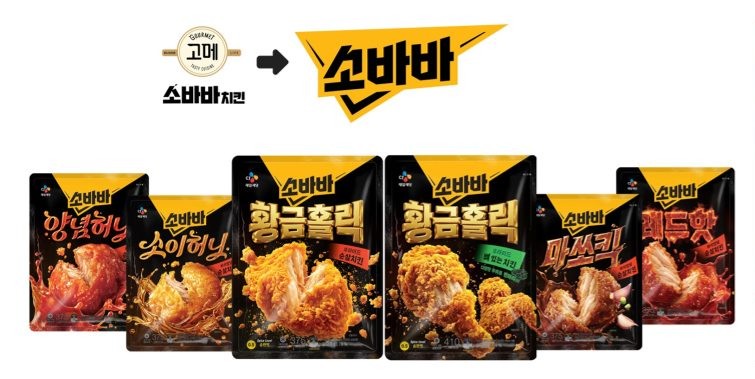
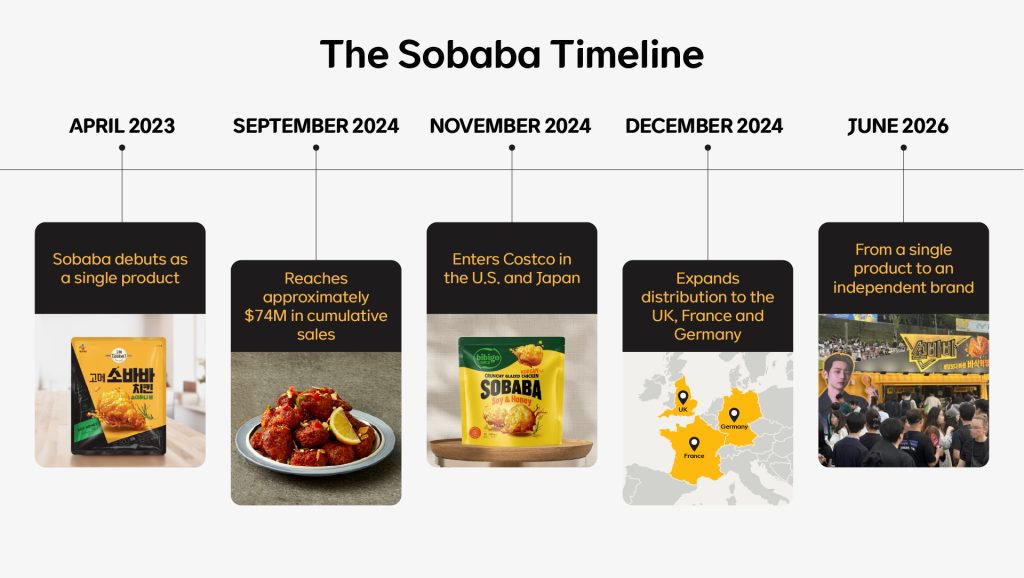
Sobaba started as a single product — one soy honey flavor — launched in April 2023 under Gourmet, CJ Foods’ premium home meal replacement brand. Consumer response was swift. The product grew quickly, reaching approximately 74 million USD in cumulative sales within a year and a half of its launch.
Global distribution followed shortly after. In November 2024, Sobaba entered Costco locations across the United States and Japan, where it was named one of Costco’s “14 Must-Try New Foods” in the U.S. A month later, distribution expanded to Europe, with the United Kingdom, France and Germany added to the network.
By June 2026, Sobaba had sold 25 million bags across these markets. What began as a single product under an existing brand was then launched as an independent brand. A pop-up event in Seoul’s Seongsu district drew 2,500 visitors over three days, and its campaign film reached 20 million views in five days.
What Brand Independence Actually Means
Sobaba’s move to independent brand status reflects three broader shifts.
First, a shift in category perception. Frozen chicken has traditionally been positioned as a convenient alternative to restaurant dining. Sobaba’s proprietary sauce-coating technology aims to bring the restaurant experience closer to the frozen category, rather than simply offering convenience.
Second, a different path to market. Many brands establish their identity before building their consumer base. CJ Foods took a different approach: it first developed the technology, validated the product in the market and expanded international distribution before launching Sobaba as an independent brand. In that sense, the independent launch reflected existing momentum rather than serving as a new beginning.
Third, an ambition beyond the freezer aisle. CJ Foods plans to grow Sobaba into a global chicken brand — one with relevance not only in retail, but also across the restaurant and delivery channels.
K-chicken’s global presence is no longer in question. The category has gained strong consumer recognition across markets, and demand continues to grow.
What Sobaba adds to that picture is broader accessibility. By addressing the technical constraints that had kept the full K-chicken experience tied to the restaurant, and by establishing a global distribution footprint before the brand was formally launched, CJ Foods aims to make that experience more widely available through retail channels across global markets.