This summary was generated with AI. We recommend reading the full article for accurate information.
K-beauty purchase experience reached 50% in 2025, as demand expanded beyond skincare into hair care, body care and beauty devices. Growth spread across Europe, Australia and the Middle East, with Amazon and TikTok Shop serving as major channels for trend-driven products and viral brands.
Retailers responded through different strategies: Sephora emphasized curated brand stories, Walmart focused on proven brands, and Target introduced newer-to-store labels. OLIVE YOUNG expanded through its Sephora partnership and U.S. stores, using Korean sales data, routine-based curation and in-person services to connect consumers with K-beauty.
This article examines data from the year in which K-beauty crossed from “interest” to “purchase.” Using the K-beauty purchase experience indicator from the CJ Global K-Wave Consumer Survey (December 2025; 7,100 respondents aged 15 to 49 across 12 countries), the responses of Amazon, TikTok Shop, Sephora, Target and Walmart, and OLIVE YOUNG’s Sephora partnership and direct entry into the United States, it looks at where and how expanded demand for K-beauty is meeting consumers.
K-Beauty, From Interest to Spending — An Expanding Category and Market
“Plenty of interest but few actual purchases” was the label that followed K-beauty through 2024. It was a daily talking point in content and on social media, yet relatively few consumers actually opened their wallets. In just one year, that equation changed.
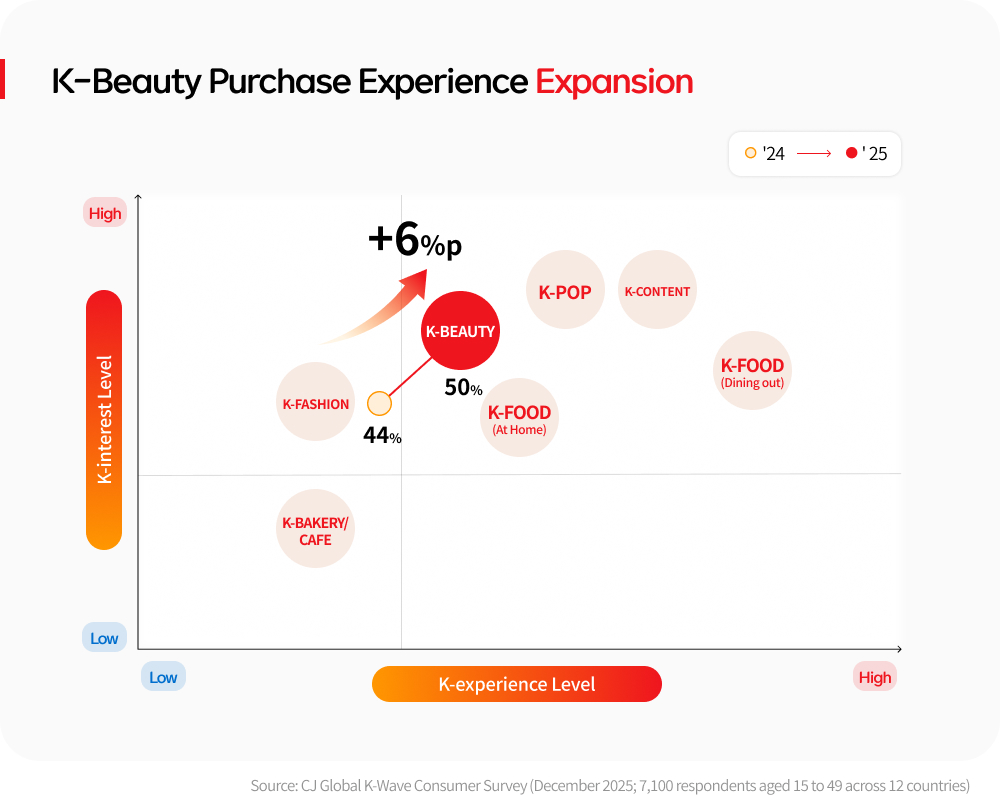
According to the CJ Global K-Wave Consumer Survey, K-beauty purchase experiences reached 50% in 2025, up 6 percentage points year over year. The link that turns interest into purchase strengthened to a meaningful degree in the span of a year.
A chart plotting each industry’s position by K-interest (vertical axis) and K-experience (horizontal axis). K-beauty rose in both interest and experience in 2025 compared with 2024, moving into the upper-right area occupied by K-pop, K-content and K-food (dining out). Other industries are shown at their 2025 positions only. Source: CJ Global K-Wave Consumer Survey.
The Expanding K-Beauty Experience: From the Face to Hair and Body
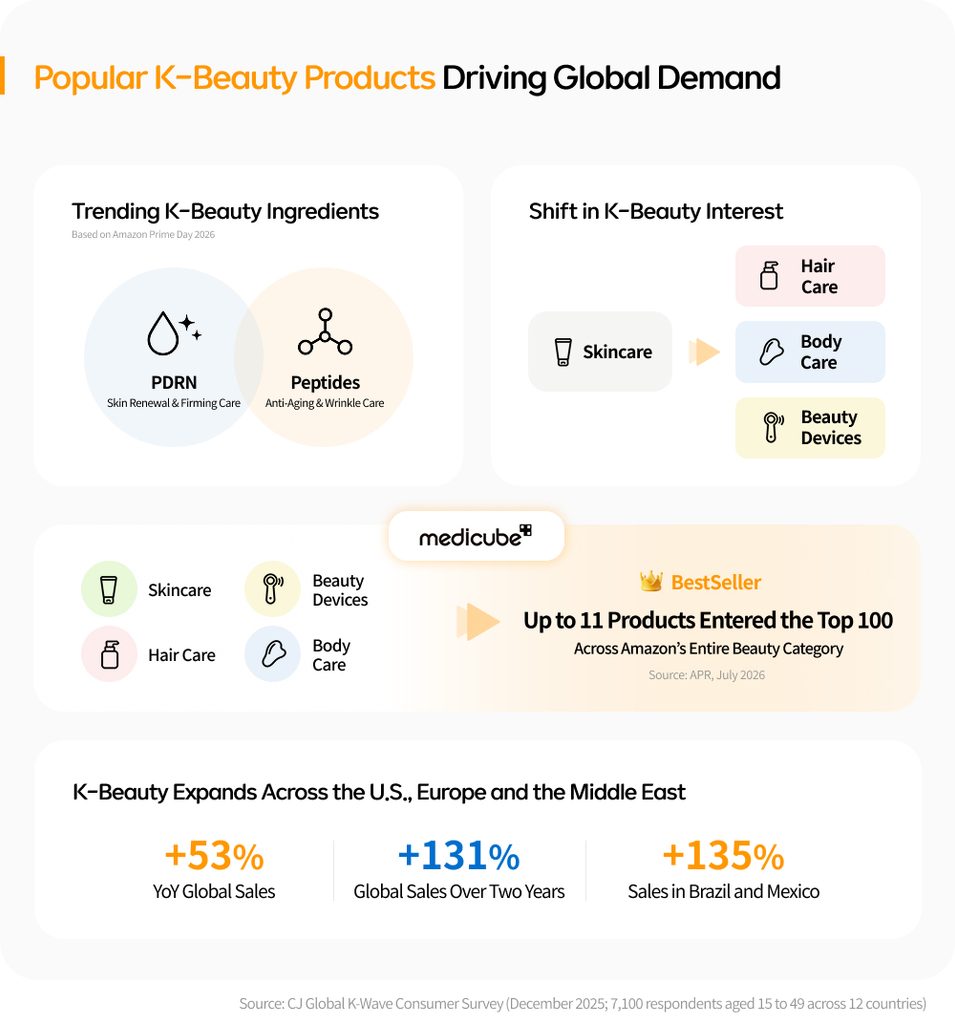
In the past, products that were already well known often stayed popular for a long time. Now it is new products that lead the market. On Prime Day in 2026, K-beauty products released less than a year earlier drew strong demand. Products built around ingredients that are currently major talking points in Korea, such as PDRN and peptides, drew particularly good responses.
K-beauty had previously centered on skincare such as toners, serums and creams, but interest has recently spread to hair care, such as shampoos and treatments, body care and at-home beauty devices.
On the strength of its skincare and beauty devices, medicube extended into hair care and body care products, and on Prime Day, it placed 11 products in the top 100 bestsellers across Amazon’s entire beauty category (APR announcement, July 2026).
The Expanding K-Beauty Experience: Past the U.S. to Europe and the Middle East
Where the popularity of K-beauty once leaned heavily on countries such as China or the U.S., growth in the K-beauty experience is now spreading through Europe, Australia and the Middle East. According to NIQ’s “K-Beauty Goes Global” report (July 2026), K-beauty sales rose 53% year over year and 131% globally over the past two years, and grew 135% in Brazil and Mexico as well.
Intensifying Global Competition — How Each Retailer Is Responding
As interest in K-beauty converts into spending, many retailers are racing to expand their K-beauty product and brand assortments.
Amazon and TikTok Shop – the ‘Proving Ground for K-Beauty Demand’ Built by Ingredient Trends and Short-Form Virality
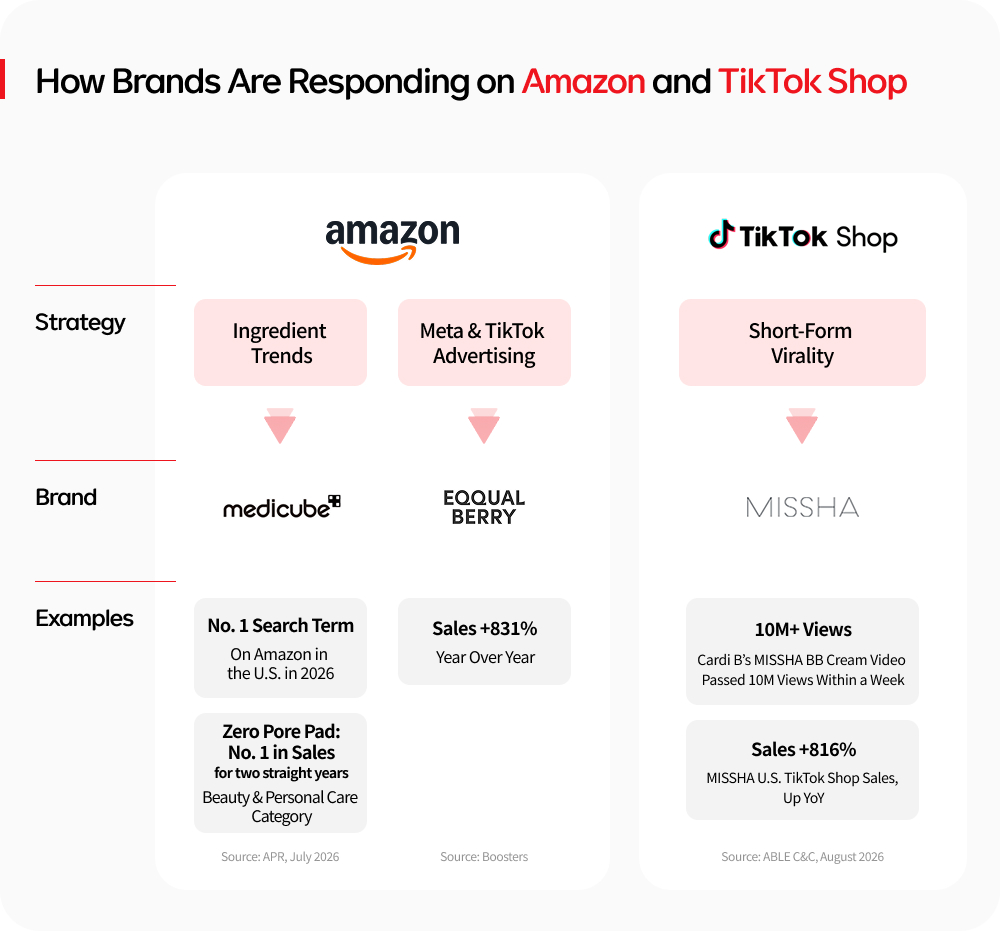
The place that shows that shift from interest to spending most plainly is Amazon. Amazon remains the single most important gateway for buying K-beauty. According to the CJ Global K-Wave Consumer Survey, Amazon is cited as a leading channel for K-beauty purchases in major markets including the U.S., the United Kingdom, Germany, France, the Middle East and Japan. On Amazon Prime Day in the U.S. in 2026 (June 23 to 26), medicube took the No. 1 spot among all search terms on Amazon in the U.S., and its signature product, Zero Pore Pads, held the No. 1 sales position in the beauty and personal care category for a second straight year (APR, July 2026). Two forces drive Amazon. First, K-beauty products released less than a year earlier, reflecting ingredient trends such as PDRN and peptides, drew strong demand; second, EQQUALBERRY, using Meta and TikTok advertising, lifted its Prime Day sales 831% year over year (announcement by its operator, Boosters).
Alongside Amazon, the other gateway that has emerged for K-beauty is TikTok Shop. According to an NIQ report (July 2026) citing TikTok Shop’s published data, sales of K-beauty brands on TikTok Shop in the U.S., U.K., Spain and Germany rose 430% year over year. Cardi B’s video on the MISSHA BB cream passed 10 million views within a week, and MISSHA’s TikTok Shop sales in the U.S. rose 816% from January to July 2026 compared with the same period a year earlier (ABLE C&C, August 2026).
Specialty Beauty Stores (Sephora) — Curation Centered on Ingredients and Heritage
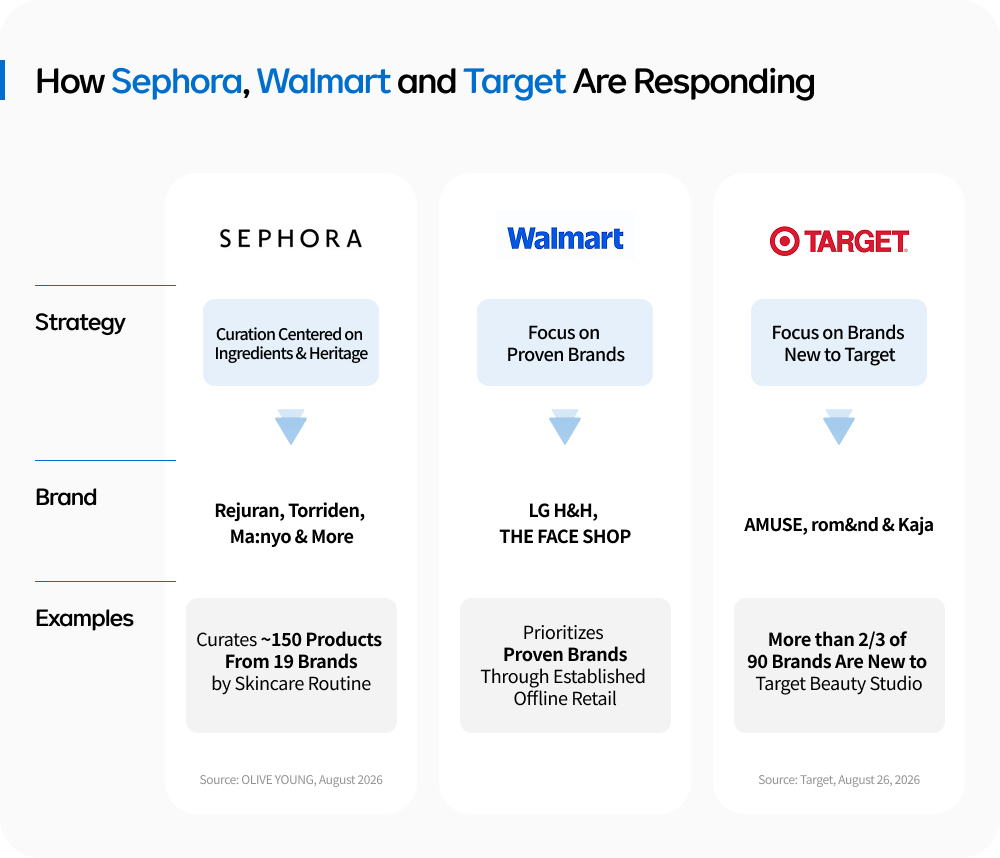
Sephora, too, is moving aggressively on K-beauty in the U.S. and Europe. In the U.S., through the OLIVE YOUNG K-Beauty Edit created with OLIVE YOUNG, it curated roughly 150 products from 19 brands including Rejuran, Torriden and Ma:nyo, organized by skincare routine (OLIVE YOUNG, August 2026). This approach favors products with a “convincing brand story” over “one-off buzz.”
Global Retailers (Walmart and Target) — a Steady Play Centered on Proven Brands
The traditional offline powers have generally given priority to brands that are already proven. Walmart brought LG H&H and THE FACE SHOP into its stores, and while accessibility is high, the freshness of the brand lineup is correspondingly lower. Target, by contrast, opened the Target Beauty Studio (opened September 10, 2026) and filled more than two-thirds of its 90 brands with brands entering Target for the first time, bringing in the K-beauty brands AMUSE, rom&nd and Kaja (Target announcement, August 26, 2026). Amid competition that crowds around already proven brands, the studio chose to differentiate itself by being first to bring in brands its stores did not carry.
OLIVE YOUNG, Growing Alongside K-Beauty
As K-beauty grows, online channels are working to meet K-beauty demand, traditional retail powers are widening accessibility with proven brands, and specialty beauty stores are curating collections by selecting brands with a story. With such intensifying K-beauty competition, where and how expanded K-beauty demand is connected to consumers matters more than ever.
OLIVE YOUNG’S Own Approach — Curation Proven in K-Beauty’s Home Market
One approach is the partnership with Sephora. On August 20, 2026, the OLIVE YOUNG K-Beauty Edit officially launched at more than 580 Sephora stores in the U.S. and on its online store (OLIVE YOUNG). The brands that OLIVE YOUNG curates are selected not due to social media buzz or search volume but on the basis of actual sales data from more than 1,300 stores in Korea, which puts its selection criteria on a different starting point from those of other retailers. By curating proven small, midsize and indie brands this way, OLIVE YOUNG lowers the barrier to entry into major global retailers that individual brands have found hard to clear, and the program is set to widen from Singapore in September 2026 to Malaysia, Thailand and Hong Kong within the year, and to Canada, Australia, the U.K. and the Middle East in 2027 (OLIVE YOUNG announcements, August and September 2026).
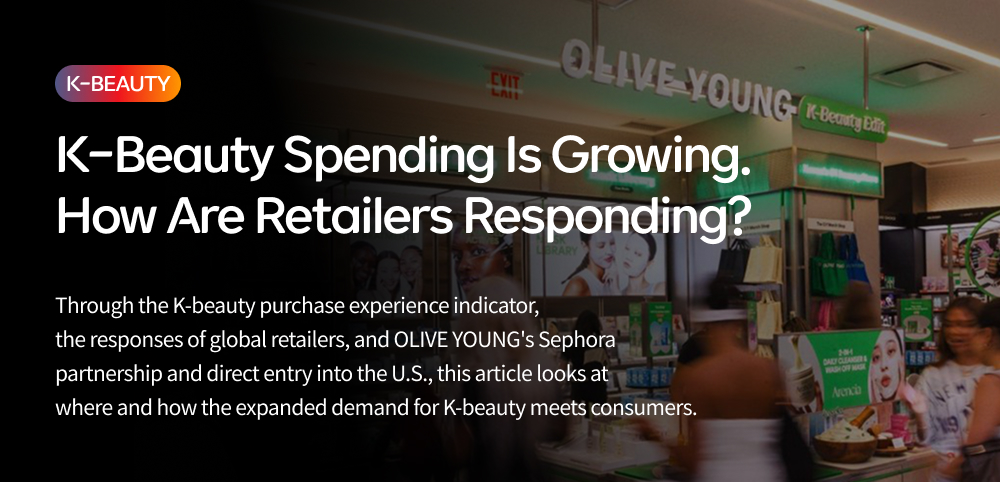
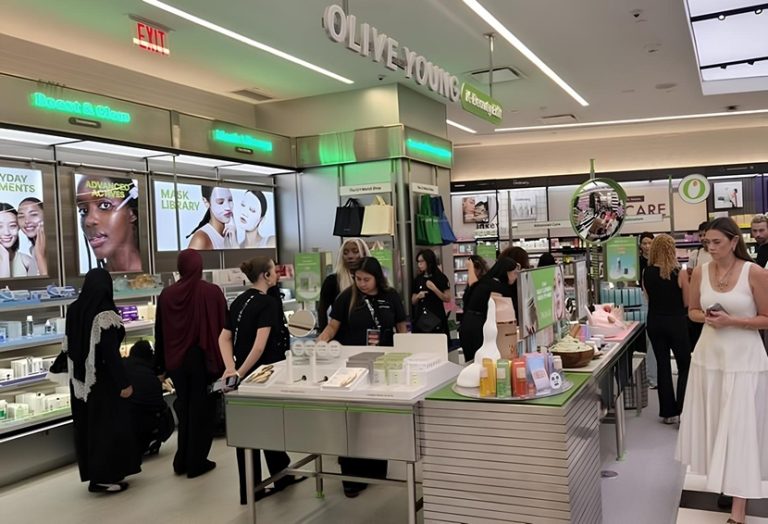
The dedicated OLIVE YOUNG K-Beauty Edit display installed inside a Sephora store in New York. Skincare products are arranged beneath the OLIVE YOUNG sign as customers look them over. Courtesy of OLIVE YOUNG.
OLIVE YOUNG’s Own Approach — a Place That Sells K-Beauty Routines and Experiences
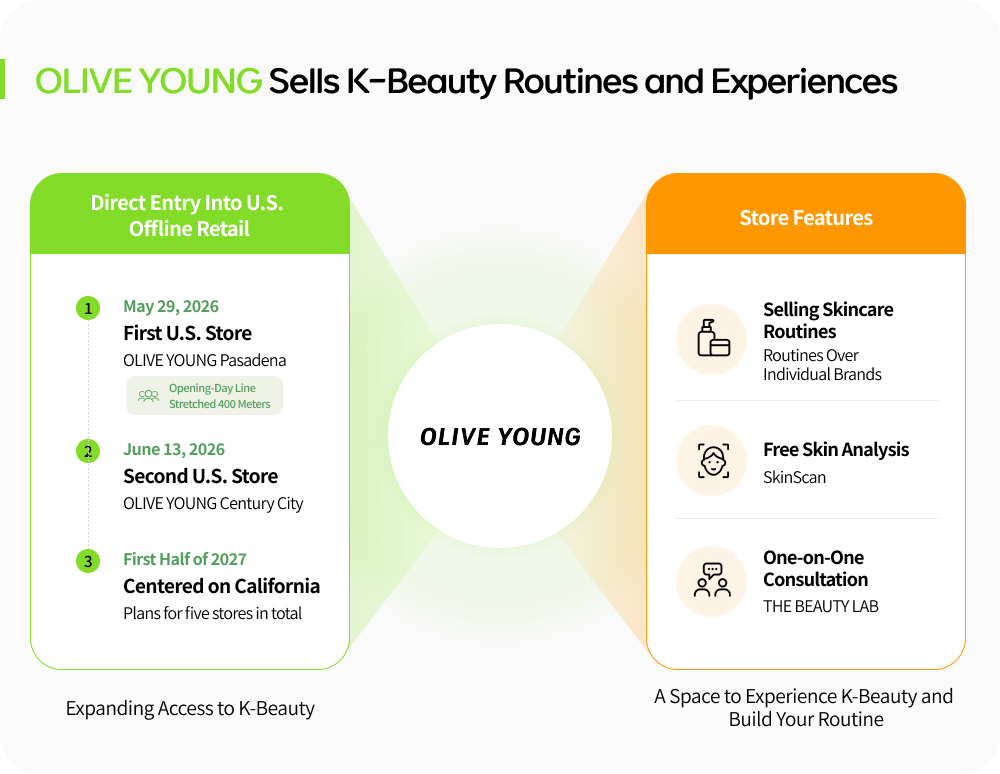
The other approach is direct entry into offline retail. On May 29, 2026 (local time), the company opened its first store in the U.S., OLIVE YOUNG Pasadena, in Pasadena, California, drawing an opening-day line that stretched 400 meters. On June 13 (local time), it opened its second store, OLIVE YOUNG Century City, at the Westfield Century City in Los Angeles (OLIVE YOUNG). The company plans to expand to a total of five stores in California by the first half of 2027 (same announcement). What sets OLIVE YOUNG’s directly operated stores apart is that they sell skincare routines rather than individual brands. With the free skin analysis service SkinScan and the one-on-one consultation THE BEAUTY LAB, they are designed as spaces where shoppers experience K-beauty firsthand and put their routines together.
Widening accessibility through speed and scale with the Sephora B2B business while building brand trust through directly operated stores, this two-track structure highlights how OLIVE YOUNG’s role is expanding past that of a simple beauty retailer into a gateway to K-beauty and the K-lifestyle.
Key Takeaways
It was the year K-beauty crossed from interest to purchase. In the CJ Global K-Wave Consumer Survey, K-beauty purchase experiences reached 50% in 2025, up 6 percentage points year over year.
New products and ingredients lead the market, and the category has widened from the face to hair and body. On Prime Day in 2026, K-beauty products released less than a year earlier sold strongly, and products built around PDRN and peptides drew good responses. K-beauty, once centered on skincare, spread into hair care, body care and at-home beauty devices, and medicube placed 11 products in the top 100 bestsellers across the entire beauty category on Prime Day (APR announcement).
The market has moved past the U.S. Leaving behind a structure that leaned on China or the U.S., growth in the K-beauty experience continues across Europe, Australia and the Middle East. In an NIQ report (July 2026), global K-beauty sales rose 53% year over year.
Amazon is the stage where K-beauty demand proved itself in numbers. On Amazon Prime Day in the U.S. in 2026, medicube took the No. 1 spot among all search terms, and Zero Pore Pads held the No. 1 sales position in the beauty and personal care category for a second straight year (APR announcement). EQQUALBERRY lifted its Prime Day sales 831% year over year with Meta and TikTok advertising (announcement by its operator, Boosters).
TikTok Shop has risen as another gateway. Sales of K-beauty brands on TikTok Shop in the U.S., U.K., Spain and Germany rose 430% year over year (NIQ report, July 2026). Cardi B’s video featuring MISSHA BB cream passed 10 million views within a week (ABLE C&C announcement).
Responses differ from retailer to retailer. Sephora selected products around brand stories, while Walmart brought in proven brands such as LG H&H and THE FACE SHOP. Target filled more than two-thirds of the 90 brands at Target Beauty Studio with brands entering Target for the first time (Target announcement).
OLIVE YOUNG differentiates with domestic sales data, selling routines and experiences through direct entry. Selecting brands on actual sales data from more than 1,300 stores in Korea, the company launched the K-Beauty Edit at more than 580 Sephora locations in the U.S. and on the online store in August 2026, and will widen to Singapore in September 2026, to Malaysia, Thailand and Hong Kong within the year, and to Canada, Australia, the U.K. and the Middle East in 2027. It opened OLIVE YOUNG Pasadena on May 29, 2026, and OLIVE YOUNG Century City on June 13, equipped them with the free skin analysis service SkinScan and the one-on-one consultation THE BEAUTY LAB, and will grow to five stores in California by the first half of 2027 (Olive Young announcement).
Frequently Asked Questions
A. Not anymore. In the CJ Global K-Wave Consumer Survey, K-beauty purchase experiences reached 50% in 2025, up 6 percentage points year over year. On Amazon Prime Day in the U.S. in 2026, medicube took the No. 1 spot among all search terms, and Zero Pore Pads held the No. 1 sales position in the beauty and personal care category for a second straight year (APR announcement). According to an NIQ report (July 2026), global K-beauty sales rose 53% year over year.
A. K-beauty, once centered on skincare such as toners, serums and creams, has widened into hair care such as shampoos and treatments, body care, and at-home beauty devices. On Prime Day in 2026, products released less than a year earlier sold strongly, and products built around PDRN or peptides drew good responses. medicube, known for skincare and beauty devices, widened its lineup into hair care and body care, and on Prime Day in 2026, it placed 11 products in the top 100 bestsellers across Amazon’s entire beauty category (APR announcement).
A. Their responses are generally split four ways. Amazon and TikTok Shop serve as the stage where demand is proven through ingredient trends and short-form virality. Sephora selects products with a brand story over one-off buzz. Walmart brings in brands that are already proven, such as LG H&H and THE FACE SHOP, and Target opened Target Beauty Studio and filled more than two-thirds of its 90 brands with brands entering Target for the first time (Target, August 2026). OLIVE YOUNG supplies brands proven by domestic sales data through the Sephora K-Beauty Edit and sells skincare routines at its directly operated stores in the U.S.
A. According to an NIQ report (July 2026) citing TikTok Shop’s published data, sales of K-beauty brands on TikTok Shop in the U.S., U.K., Spain and Germany rose 430% year over year. The MISSHA BB cream video posted by Cardi B passed 10 million views, and MISSHA’s TikTok Shop sales in the U.S. rose 816% from January to July 2026 compared with the same period a year earlier (ABLE C&C, August 2026).
A. The OLIVE YOUNG K-Beauty Edit is a K-beauty curation service that OLIVE YOUNG officially launched with Sephora on August 20, 2026, at more than 580 Sephora stores in the U.S. and on its online store. It brings together roughly 150 products from 19 brands including Rejuran, Torriden and Ma:nyo, organized by skincare routine. The selection criteria are not based on social media buzz or search volume but actual sales data from more than 1,300 stores in Korea. Starting with Singapore in September 2026, it is set to expand to Malaysia, Thailand and Hong Kong within the year and to Canada, Australia, the U.K. and the Middle East in 2027 (OLIVE YOUNG).
A. OLIVE YOUNG opened its first store in the U.S., OLIVE YOUNG Pasadena, in Pasadena, California on May 29, 2026, local time, and an opening-day line stretching 400 meters followed. On June 13 it opened its second store, OLIVE YOUNG Century City, at the Westfield Century City in Los Angeles. The stores are designed as spaces that sell skincare routines rather than individual brands, and they offer the free skin analysis service SkinScan and the one-on-one consultation THE BEAUTY LAB. The company plans to expand to a total of five stores in California by the first half of 2027 (OLIVE YOUNG).
A. In the U.S., there are five ways to buy K-beauty skincare. Online, the leading purchase channels are Amazon and TikTok Shop, while offline, K-beauty brands can be bought through the OLIVE YOUNG K-Beauty Edit at more than 580 Sephora stores, Target Beauty Studio and Walmart. OLIVE YOUNG’s directly operated stores are in Pasadena, California (first store) and Century City in Los Angeles (second store). In the CJ Global K-Wave Consumer Survey, consumers in major markets including the U.S., U.K., Germany, France, the Middle East and Japan named Amazon as a leading channel for buying K-beauty.
This article examines data from the year in which K-beauty crossed from “interest” to “purchase.” Using the K-beauty purchase experience indicator from the CJ Global K-Wave Consumer Survey (December 2025; 7,100 respondents aged 15 to 49 across 12 countries), the responses of Amazon, TikTok Shop, Sephora, Target and Walmart, and OLIVE YOUNG’s Sephora partnership and direct entry into the United States, it looks at where and how expanded demand for K-beauty is meeting consumers.
K-Beauty, From Interest to Spending — An Expanding Category and Market
“Plenty of interest but few actual purchases” was the label that followed K-beauty through 2024. It was a daily talking point in content and on social media, yet relatively few consumers actually opened their wallets. In just one year, that equation changed.
According to the CJ Global K-Wave Consumer Survey, K-beauty purchase experiences reached 50% in 2025, up 6 percentage points year over year. The link that turns interest into purchase strengthened to a meaningful degree in the span of a year.
A chart plotting each industry’s position by K-interest (vertical axis) and K-experience (horizontal axis). K-beauty rose in both interest and experience in 2025 compared with 2024, moving into the upper-right area occupied by K-pop, K-content and K-food (dining out). Other industries are shown at their 2025 positions only. Source: CJ Global K-Wave Consumer Survey.
The Expanding K-Beauty Experience: From the Face to Hair and Body
In the past, products that were already well known often stayed popular for a long time. Now it is new products that lead the market. On Prime Day in 2026, K-beauty products released less than a year earlier drew strong demand. Products built around ingredients that are currently major talking points in Korea, such as PDRN and peptides, drew particularly good responses.
K-beauty had previously centered on skincare such as toners, serums and creams, but interest has recently spread to hair care, such as shampoos and treatments, body care and at-home beauty devices.
On the strength of its skincare and beauty devices, medicube extended into hair care and body care products, and on Prime Day, it placed 11 products in the top 100 bestsellers across Amazon’s entire beauty category (APR announcement, July 2026).
The Expanding K-Beauty Experience: Past the U.S. to Europe and the Middle East
Where the popularity of K-beauty once leaned heavily on countries such as China or the U.S., growth in the K-beauty experience is now spreading through Europe, Australia and the Middle East. According to NIQ’s “K-Beauty Goes Global” report (July 2026), K-beauty sales rose 53% year over year and 131% globally over the past two years, and grew 135% in Brazil and Mexico as well.
Intensifying Global Competition — How Each Retailer Is Responding
As interest in K-beauty converts into spending, many retailers are racing to expand their K-beauty product and brand assortments.
Amazon and TikTok Shop – the ‘Proving Ground for K-Beauty Demand’ Built by Ingredient Trends and Short-Form Virality
The place that shows that shift from interest to spending most plainly is Amazon. Amazon remains the single most important gateway for buying K-beauty. According to the CJ Global K-Wave Consumer Survey, Amazon is cited as a leading channel for K-beauty purchases in major markets including the U.S., the United Kingdom, Germany, France, the Middle East and Japan. On Amazon Prime Day in the U.S. in 2026 (June 23 to 26), medicube took the No. 1 spot among all search terms on Amazon in the U.S., and its signature product, Zero Pore Pads, held the No. 1 sales position in the beauty and personal care category for a second straight year (APR, July 2026). Two forces drive Amazon. First, K-beauty products released less than a year earlier, reflecting ingredient trends such as PDRN and peptides, drew strong demand; second, EQQUALBERRY, using Meta and TikTok advertising, lifted its Prime Day sales 831% year over year (announcement by its operator, Boosters).
Alongside Amazon, the other gateway that has emerged for K-beauty is TikTok Shop. According to an NIQ report (July 2026) citing TikTok Shop’s published data, sales of K-beauty brands on TikTok Shop in the U.S., U.K., Spain and Germany rose 430% year over year. Cardi B’s video on the MISSHA BB cream passed 10 million views within a week, and MISSHA’s TikTok Shop sales in the U.S. rose 816% from January to July 2026 compared with the same period a year earlier (ABLE C&C, August 2026).
Specialty Beauty Stores (Sephora) — Curation Centered on Ingredients and Heritage
Sephora, too, is moving aggressively on K-beauty in the U.S. and Europe. In the U.S., through the OLIVE YOUNG K-Beauty Edit created with OLIVE YOUNG, it curated roughly 150 products from 19 brands including Rejuran, Torriden and Ma:nyo, organized by skincare routine (OLIVE YOUNG, August 2026). This approach favors products with a “convincing brand story” over “one-off buzz.”
Global Retailers (Walmart and Target) — a Steady Play Centered on Proven Brands
The traditional offline powers have generally given priority to brands that are already proven. Walmart brought LG H&H and THE FACE SHOP into its stores, and while accessibility is high, the freshness of the brand lineup is correspondingly lower. Target, by contrast, opened the Target Beauty Studio (opened September 10, 2026) and filled more than two-thirds of its 90 brands with brands entering Target for the first time, bringing in the K-beauty brands AMUSE, rom&nd and Kaja (Target announcement, August 26, 2026). Amid competition that crowds around already proven brands, the studio chose to differentiate itself by being first to bring in brands its stores did not carry.
OLIVE YOUNG, Growing Alongside K-Beauty
As K-beauty grows, online channels are working to meet K-beauty demand, traditional retail powers are widening accessibility with proven brands, and specialty beauty stores are curating collections by selecting brands with a story. With such intensifying K-beauty competition, where and how expanded K-beauty demand is connected to consumers matters more than ever.
OLIVE YOUNG’S Own Approach — Curation Proven in K-Beauty’s Home Market
One approach is the partnership with Sephora. On August 20, 2026, the OLIVE YOUNG K-Beauty Edit officially launched at more than 580 Sephora stores in the U.S. and on its online store (OLIVE YOUNG). The brands that OLIVE YOUNG curates are selected not due to social media buzz or search volume but on the basis of actual sales data from more than 1,300 stores in Korea, which puts its selection criteria on a different starting point from those of other retailers. By curating proven small, midsize and indie brands this way, OLIVE YOUNG lowers the barrier to entry into major global retailers that individual brands have found hard to clear, and the program is set to widen from Singapore in September 2026 to Malaysia, Thailand and Hong Kong within the year, and to Canada, Australia, the U.K. and the Middle East in 2027 (OLIVE YOUNG announcements, August and September 2026).
The dedicated OLIVE YOUNG K-Beauty Edit display installed inside a Sephora store in New York. Skincare products are arranged beneath the OLIVE YOUNG sign as customers look them over. Courtesy of OLIVE YOUNG.
OLIVE YOUNG’s Own Approach — a Place That Sells K-Beauty Routines and Experiences
The other approach is direct entry into offline retail. On May 29, 2026 (local time), the company opened its first store in the U.S., OLIVE YOUNG Pasadena, in Pasadena, California, drawing an opening-day line that stretched 400 meters. On June 13 (local time), it opened its second store, OLIVE YOUNG Century City, at the Westfield Century City in Los Angeles (OLIVE YOUNG). The company plans to expand to a total of five stores in California by the first half of 2027 (same announcement). What sets OLIVE YOUNG’s directly operated stores apart is that they sell skincare routines rather than individual brands. With the free skin analysis service SkinScan and the one-on-one consultation THE BEAUTY LAB, they are designed as spaces where shoppers experience K-beauty firsthand and put their routines together.
Widening accessibility through speed and scale with the Sephora B2B business while building brand trust through directly operated stores, this two-track structure highlights how OLIVE YOUNG’s role is expanding past that of a simple beauty retailer into a gateway to K-beauty and the K-lifestyle.
Key Takeaways
It was the year K-beauty crossed from interest to purchase. In the CJ Global K-Wave Consumer Survey, K-beauty purchase experiences reached 50% in 2025, up 6 percentage points year over year.
New products and ingredients lead the market, and the category has widened from the face to hair and body. On Prime Day in 2026, K-beauty products released less than a year earlier sold strongly, and products built around PDRN and peptides drew good responses. K-beauty, once centered on skincare, spread into hair care, body care and at-home beauty devices, and medicube placed 11 products in the top 100 bestsellers across the entire beauty category on Prime Day (APR announcement).
The market has moved past the U.S. Leaving behind a structure that leaned on China or the U.S., growth in the K-beauty experience continues across Europe, Australia and the Middle East. In an NIQ report (July 2026), global K-beauty sales rose 53% year over year.
Amazon is the stage where K-beauty demand proved itself in numbers. On Amazon Prime Day in the U.S. in 2026, medicube took the No. 1 spot among all search terms, and Zero Pore Pads held the No. 1 sales position in the beauty and personal care category for a second straight year (APR announcement). EQQUALBERRY lifted its Prime Day sales 831% year over year with Meta and TikTok advertising (announcement by its operator, Boosters).
TikTok Shop has risen as another gateway. Sales of K-beauty brands on TikTok Shop in the U.S., U.K., Spain and Germany rose 430% year over year (NIQ report, July 2026). Cardi B’s video featuring MISSHA BB cream passed 10 million views within a week (ABLE C&C announcement).
Responses differ from retailer to retailer. Sephora selected products around brand stories, while Walmart brought in proven brands such as LG H&H and THE FACE SHOP. Target filled more than two-thirds of the 90 brands at Target Beauty Studio with brands entering Target for the first time (Target announcement).
OLIVE YOUNG differentiates with domestic sales data, selling routines and experiences through direct entry. Selecting brands on actual sales data from more than 1,300 stores in Korea, the company launched the K-Beauty Edit at more than 580 Sephora locations in the U.S. and on the online store in August 2026, and will widen to Singapore in September 2026, to Malaysia, Thailand and Hong Kong within the year, and to Canada, Australia, the U.K. and the Middle East in 2027. It opened OLIVE YOUNG Pasadena on May 29, 2026, and OLIVE YOUNG Century City on June 13, equipped them with the free skin analysis service SkinScan and the one-on-one consultation THE BEAUTY LAB, and will grow to five stores in California by the first half of 2027 (Olive Young announcement).
Frequently Asked Questions
Is K-beauty all interest and no actual sales?
A. Not anymore. In the CJ Global K-Wave Consumer Survey, K-beauty purchase experiences reached 50% in 2025, up 6 percentage points year over year. On Amazon Prime Day in the U.S. in 2026, medicube took the No. 1 spot among all search terms, and Zero Pore Pads held the No. 1 sales position in the beauty and personal care category for a second straight year (APR announcement). According to an NIQ report (July 2026), global K-beauty sales rose 53% year over year.
Which K-beauty categories are popular right now?
A. K-beauty, once centered on skincare such as toners, serums and creams, has widened into hair care such as shampoos and treatments, body care, and at-home beauty devices. On Prime Day in 2026, products released less than a year earlier sold strongly, and products built around PDRN or peptides drew good responses. medicube, known for skincare and beauty devices, widened its lineup into hair care and body care, and on Prime Day in 2026, it placed 11 products in the top 100 bestsellers across Amazon’s entire beauty category (APR announcement).
How are global retailers responding to K-beauty?
A. Their responses are generally split four ways. Amazon and TikTok Shop serve as the stage where demand is proven through ingredient trends and short-form virality. Sephora selects products with a brand story over one-off buzz. Walmart brings in brands that are already proven, such as LG H&H and THE FACE SHOP, and Target opened Target Beauty Studio and filled more than two-thirds of its 90 brands with brands entering Target for the first time (Target, August 2026). OLIVE YOUNG supplies brands proven by domestic sales data through the Sephora K-Beauty Edit and sells skincare routines at its directly operated stores in the U.S.
How much K-beauty is sold on TikTok Shop?
A. According to an NIQ report (July 2026) citing TikTok Shop’s published data, sales of K-beauty brands on TikTok Shop in the U.S., U.K., Spain and Germany rose 430% year over year. The MISSHA BB cream video posted by Cardi B passed 10 million views, and MISSHA’s TikTok Shop sales in the U.S. rose 816% from January to July 2026 compared with the same period a year earlier (ABLE C&C, August 2026).
What is the OLIVE YOUNG K-Beauty Edit?
A. The OLIVE YOUNG K-Beauty Edit is a K-beauty curation service that OLIVE YOUNG officially launched with Sephora on August 20, 2026, at more than 580 Sephora stores in the U.S. and on its online store. It brings together roughly 150 products from 19 brands including Rejuran, Torriden and Ma:nyo, organized by skincare routine. The selection criteria are not based on social media buzz or search volume but actual sales data from more than 1,300 stores in Korea. Starting with Singapore in September 2026, it is set to expand to Malaysia, Thailand and Hong Kong within the year and to Canada, Australia, the U.K. and the Middle East in 2027 (OLIVE YOUNG).
Where are OLIVE YOUNG’s stores in the U.S.?
A. OLIVE YOUNG opened its first store in the U.S., OLIVE YOUNG Pasadena, in Pasadena, California on May 29, 2026, local time, and an opening-day line stretching 400 meters followed. On June 13 it opened its second store, OLIVE YOUNG Century City, at the Westfield Century City in Los Angeles. The stores are designed as spaces that sell skincare routines rather than individual brands, and they offer the free skin analysis service SkinScan and the one-on-one consultation THE BEAUTY LAB. The company plans to expand to a total of five stores in California by the first half of 2027 (OLIVE YOUNG).
Where can you buy K-beauty skincare outside Korea?
A. In the U.S., there are five ways to buy K-beauty skincare. Online, the leading purchase channels are Amazon and TikTok Shop, while offline, K-beauty brands can be bought through the OLIVE YOUNG K-Beauty Edit at more than 580 Sephora stores, Target Beauty Studio and Walmart. OLIVE YOUNG’s directly operated stores are in Pasadena, California (first store) and Century City in Los Angeles (second store). In the CJ Global K-Wave Consumer Survey, consumers in major markets including the U.S., U.K., Germany, France, the Middle East and Japan named Amazon as a leading channel for buying K-beauty.
K-Insight Series
The K-Growth Story, Seen Through the Data
How K-Food Is Becoming an Everyday Meal
K-Beauty Spending Is Growing. How Are Retailers Responding?
How K-Dramas and K-Pop Are Driving the ‘Next K’
We use cookies to improve your browsing experience and help us develop CJ Newsroom. By using our website you agree to the use of cookies as described in our Cookies Notice.


 This summary was generated with AI. We recommend reading the full article for accurate information.